
· Nora Fenwick
How to sleep on a plane
What follows is ordered by how much difference each thing makes, rather than by how often it appears on lists.
1. Stop the head falling
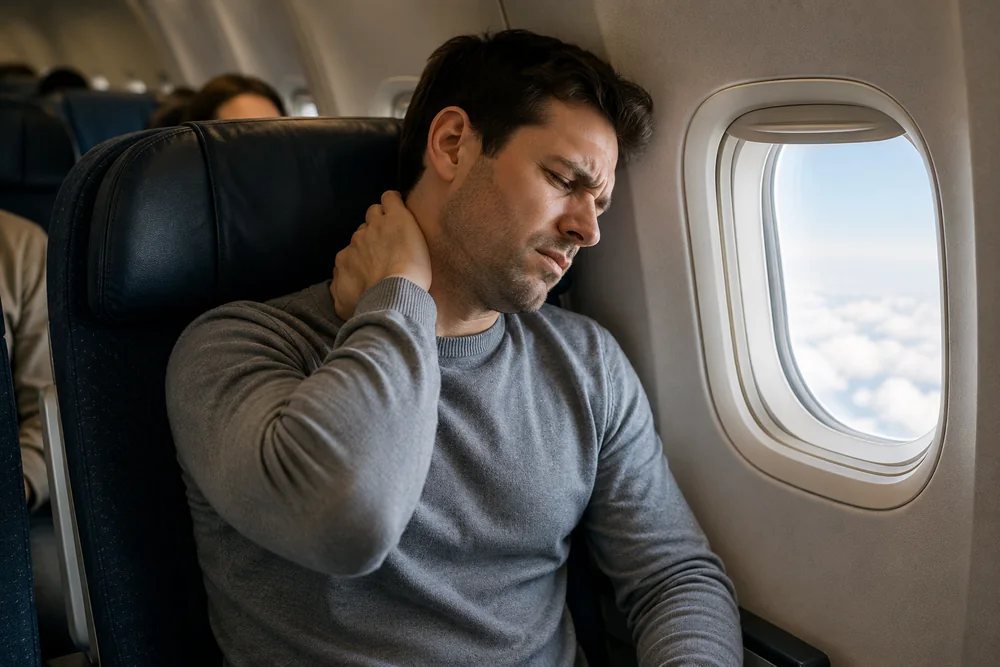
Lying down, your neck muscles switch off and the mattress takes over. Sitting up, they switch off too — but nothing takes over. The head begins to travel, the muscles fire to catch it, and you surface. That cycle repeats every few minutes and it is why people describe a flight as seven hours of not-quite-sleeping.
A U-shaped pillow worn correctly is the cheapest fix, and “correctly” is the operative word: the opening goes at the front, under your chin, not behind your neck. Worn the usual way round, it leaves the gap exactly where your head wants to go. The full method is here, and it is worth two minutes because most people have been wearing one backwards for years.
2. Take whatever recline you have
Even two or three inches changes the geometry: it moves your center of mass back over the seat instead of in front of it, which is the difference between your body being held and your body being balanced. Recline as soon as the seatbelt sign goes off, not when you decide to sleep — cabin crew ask you to sit up during service, and the window for reclining is earlier than people think.
3. Fill the gaps
A body sleeps when it stops making micro-corrections. Every unsupported space is a place a correction happens.
- Lower back. A rolled-up jumper behind the lumbar curve stops the slow slide down the seat.
- Between shoulder and window. If you have the window, leaning is far more stable than sitting square. Wedge something into the gap.
- Under the feet. A bag under the feet raises the knees slightly and takes pressure off the back of the thighs, which is where the numbness comes from.
4. Darkness, properly
Light suppresses melatonin, and a cabin is never really dark — screens, service lights, the window blind two rows up. An eye mask is the highest-return item in a carry-on after the pillow. A contoured one that does not press on your eyelids beats a flat strip.
5. Noise, but the right kind
Cabin noise sits around 80 to 85 dB in cruise. Earplugs cut the top off it; noise-canceling headphones handle the low rumble that earplugs miss. What people underestimate is the intermittent noise — a chime, a trolley, a child three rows back — which is what actually wakes you. Steady background sound at a low volume masks the intermittent kind better than silence does.
6. Temperature
Cabins run cool, and falling asleep requires your core temperature to drop slightly — which it cannot do if you are already cold, because your body fights to hold onto heat. Being warm enough to relax and cool enough to drift is the target. In practice: socks, a layer you can take off, and asking for a blanket before the cabin dims rather than after.
7. Time it to where you are going
The most useful decision is made before boarding: are you sleeping on this flight or staying awake on it? Sleeping on an overnight eastbound flight is worth a great deal. Sleeping for four hours on a daytime westbound flight, landing in the afternoon, mostly costs you that night’s sleep at the destination.
Set your watch to the destination as you board and behave accordingly. It sounds like folklore and it is the one habit that consistently separates people who arrive functional from people who do not.
What to be careful with
| Why it is worth thinking about | |
|---|---|
| Alcohol | Shortens the time to fall asleep and fragments what follows. Combined with cabin dehydration it usually costs more than it gives. |
| Sleeping tablets | Anything that keeps you immobile for hours in a cramped seat is a conversation to have with a doctor before the flight, not a decision to make at 35,000 feet. |
| Coffee before boarding | Caffeine has a half-life of around five hours. A cup at the gate is still working at the point you wanted to be asleep. |
| Sitting still for hours | Get up and walk when you can. Long periods of immobility carry a circulation risk, and it is one worth taking seriously on a long-haul. |
The seat matters more than any of this
All the above is what to do with the seat you have. What you can do beforehand is choose a better one — window over aisle, ahead of the galley rather than beside it, and away from the bulkhead if you want to recline. Choosing a seat for sleeping goes through the trade-offs.
And if you land with a stiff neck anyway, that is usually a sign the head was traveling all night rather than being held — what to do about it.