
Cervical pillows: what the memory foam actually does
It is the most common material in neck pillows, and the most misunderstood. Here is what it does, how it behaves, and how to tell good density from bad.
What the foam does that no ordinary filling does
A synthetic-fiber or feather pillow spreads weight by flattening. Put your head on it: the filling moves out to the sides, and the thickness under your neck drops as the hours pass. By morning there is almost nothing left under the heaviest part — your skull — while your neck was never supported at all.
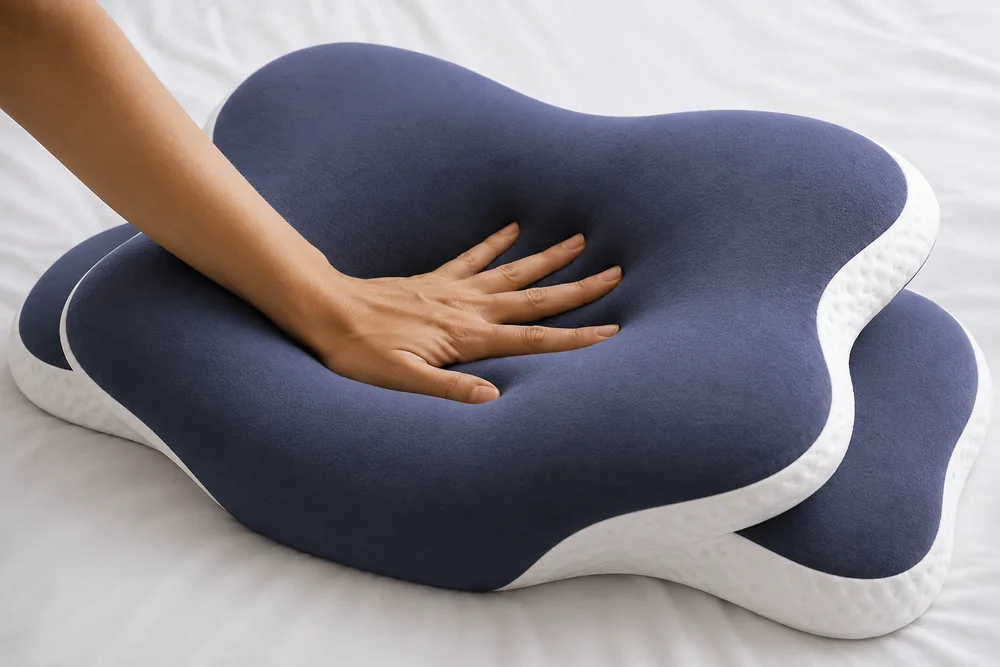
Viscoelastic foam works differently. It does not move, it compresses locally. The zone under the skull sinks, the zone under the neck stays high: that is exactly the profile a neck needs. And because the material returns to where it started, that profile is the same in the third hour as in the first.
Density, the only number that counts
Not all memory foam is equal. Low-density foam costs less, flattens more, and loses its spring within months: after a year it behaves like an ordinary filling. High-density foam holds up, but it feels firmer on first contact.
The most telling test needs no instrument: press your fist into the middle of the pillow, then take it away. Count. Decent foam comes back up in three to five seconds. If it springs back instantly, it is not viscoelastic. If the impression is still there after ten seconds, the density is too low or the foam is worn out.
Why it feels firm at bedtime
This is the most common remark from buyers coming off a soft pillow, and it turns up in the reviews of every model on the market, not only ours. Viscoelasticity depends on temperature: at 65 °F (18 °C) in a bedroom, the foam is stiff. It reaches its working softness between 86 and 95 °F (30–35 °C) — skin temperature — after two to five minutes.
In practice you lie down on a surface that feels too hard, and it gives way progressively. In winter, in a cool bedroom, it takes longer. This is not a manufacturing fault: it is the very mechanism that lets the foam take a shape and hold it.
The trade-off: heat, and what answers it
Memory foam is a solid material. Unlike a hollow fiber or down, it does not let air move through freely, and it gives back the heat it stores. That is why the industry has spent years on perforations, gels and knitted covers.
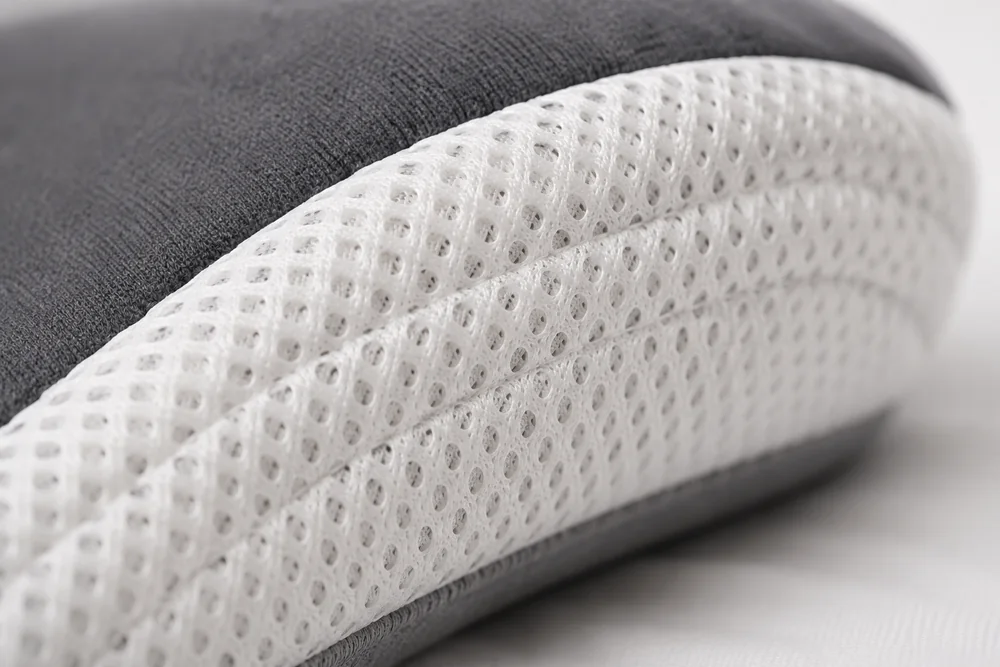
The woven side panels on recent models are not decorative: they open an air path along the sides, where skin contact lasts longest. A mesh or “cooling” cover does the same job. If you sleep under a thick comforter or in a heated bedroom, it is a criterion worth weighing.
Care: what washes and what does not
The rule is absolute and there is no exception: the foam never goes in a machine. Water gets into the cell structure, the spin cycle tears it, and drying leaves compressed patches that will never rise again. A memory foam pillow put through a washing machine is a pillow lost.
What washes is the cover. It comes off by its zip, goes in the machine at 86 °F / 30 °C, and goes back on once dry. Between washes the foam airs out for a few hours in the open, away from the direct sunlight that yellows and weakens it. An ordinary pillowcase can go over the cover, which spaces the washes out further.
What memory foam is built to do
It is made for one thing: holding your neck at the same height all night. The foam does not move, it compresses where the weight presses — the zone under the skull sinks, the zone under the neck stays high. That is exactly the profile a neck needs.
If what you want is support that does not shift overnight — the same height under your neck at three in the morning as at lights-out — this is the one material that does it reliably. Which is why it dominates the neck pillow aisle.
The smell of a new pillow, and how long it lasts
It is one of the most common searches about this material, and it deserves a straight answer rather than silence.
New viscoelastic foam releases volatile organic compounds — off-gassing. The smell is chemical, unmistakable, and it takes people by surprise. It goes within a few days to a week of airing, and it is how new foam behaves, not the sign of a fault.
Two things are enough: take the pillow out of its vacuum pack as soon as it arrives, and let it breathe for 24 to 48 hours in a ventilated room before the first night. If the smell is still there after two weeks, it is no longer off-gassing — it is damp, and that needs handling differently.
The second subject, raised less often, is heat: solid foam does not let air circulate. That is a matter of comfort, and it is answered by the cover, the pillowcase and the temperature of the room — covered above.
Young children: the question is not about the material but about age. Whether a child uses a pillow at all is a decision to take with a pediatrician.
Sizes: why a contour pillow is not a Standard pillow
This is the classic surprise on delivery, and it is worth saying up front.
Bedding sizes are named, not measured — and the same name means three different pillows depending on where you live:
| Where you buy | Standard | Queen | King |
|---|---|---|---|
| United States & Canada | 20 × 26 in | 20 × 30 in | 20 × 36 in |
| United Kingdom | 50 × 75 cm (housewife) | — | 50 × 90 cm |
| Australia | 48 × 73 cm | 51 × 76 cm | 51 × 91 cm |
Read the first column twice: a British “standard” pillowcase is nearer a US or Australian Queen than a US Standard. These are bedding formats, drawn for linen and for how a bed looks — not for holding up a neck.
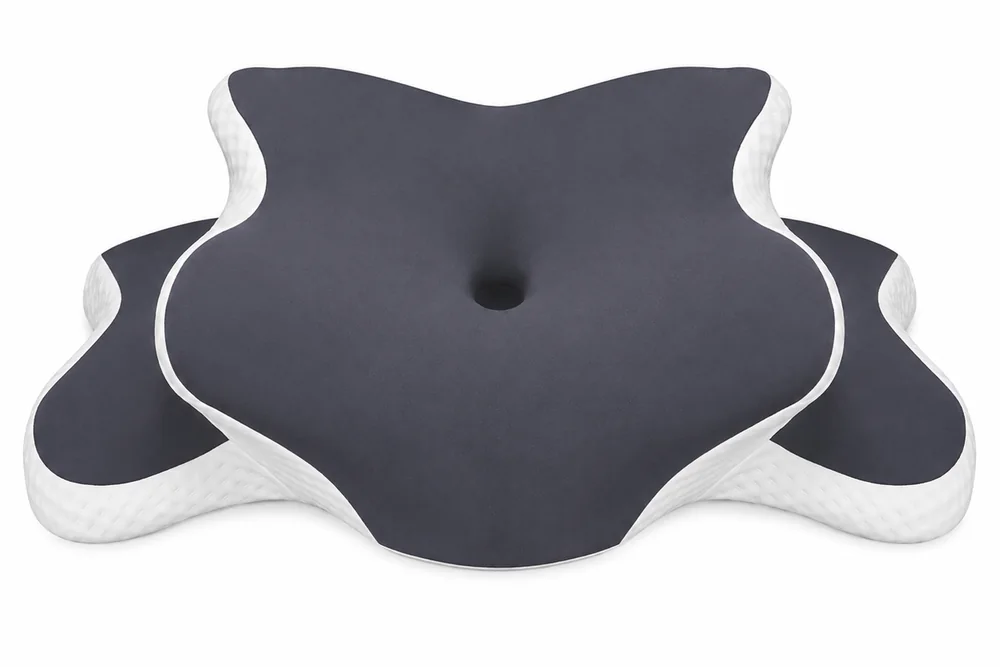
A contour pillow follows none of them. Its dimensions come from another logic: the shoulder width to fill, the room your arm needs, the height of the neck bolster. It usually runs somewhere between 20 × 12 in (50 × 30 cm) and 24 × 16 in (60 × 40 cm), and it sits lower than a bedding pillow.
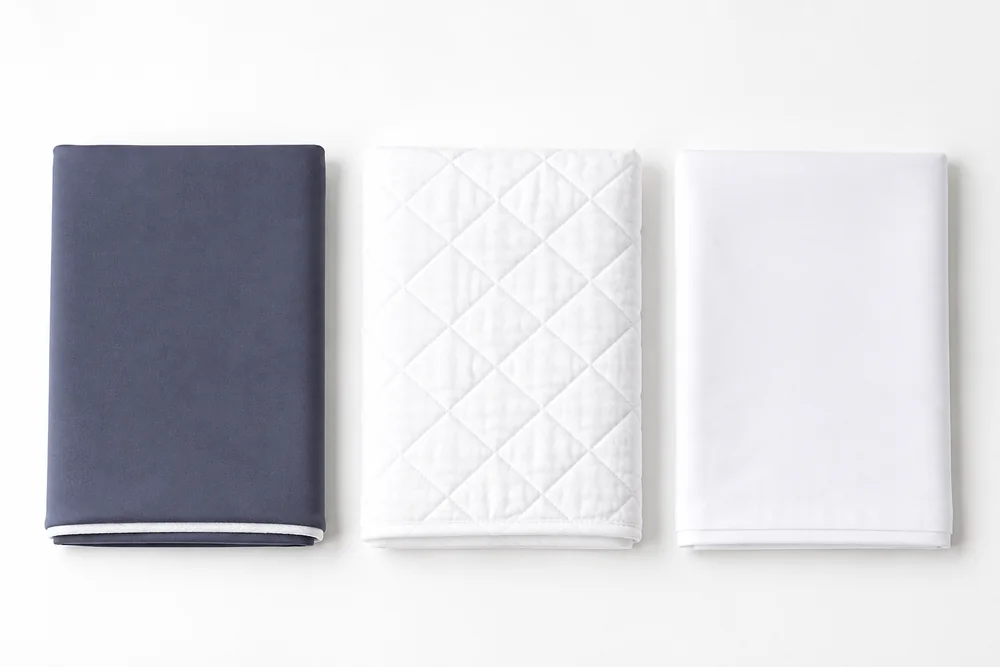
The practical consequence for your linen: a King case floats on a contour pillow, creases under your head and leaves marks by morning. A case that is too tight does the opposite — it flattens the relief and removes the thing you paid for. The right move is to measure the pillow and allow an inch or two.
That is also why these pillows ship with their own cover: it is cut for the shape, and an ordinary case goes over the top if you want one.
Common questions about memory foam
Why is a memory foam pillow hard for the first few minutes?
Viscoelastic foam reacts to heat. At room temperature it is firm; against your skin it softens in two to five minutes. That is how the material behaves, not a fault — and in a cold bedroom it takes a little longer.
Are memory foam pillows actually good for you?
For holding your neck at one height through the night, yes: it is the one thing this material does that a fiber or feather filling cannot, because it compresses in place instead of shifting sideways. It is not a treatment, and it will not fix a mattress that is wrong for you.
How long does a memory foam pillow last?
Far longer than a fiber filling, which flattens within months. High-density foam keeps its ability to spring back for several years. The wear sign is simple: an impression still visible in the morning.
Can you wash a memory foam pillow?
Never in a machine. Water and the spin cycle destroy the cell structure, and the foam stops springing back. Only the cover is washed, at 86 °F / 30 °C. The foam airs out in the open, away from direct sunlight.
Do memory foam pillows sleep hot?
Solid foam holds more heat than a hollow fiber. A knitted or mesh cover moves air along the sides, which is what the woven side panels on recent models are for. Worth weighing if you sleep in a heated bedroom.
Will it fit a Standard pillowcase?
A contour pillow is shaped, not sized like bedding, and it ships with its own zip-off cover. If you want a case over the top, measure the pillow and allow an inch or two — and note that a UK “standard” case is closer to a US or Australian Queen than to a US Standard.