
Ergonomic pillow: does the idea hold up?
The word is borrowed from the workplace, where it means chairs and keyboards. Sleep is a different problem, and the difference is the interesting part.
Where the word comes from
Ergonomics grew up in factories and offices: fit the tool to the worker. Raise the monitor to eye level rather than telling someone to sit up. Angle the keyboard rather than telling the wrist to bend. The whole discipline rests on one observation — over enough hours, a body will not hold a position it has to work at.
That observation transfers to a bed exactly, and the hours are longer. Nobody maintains good posture while asleep. Whatever angle the surface sets, the neck adopts, for as long as you are on it. So the surface has to be right, because there is nobody awake to correct it.
Sleep is not a desk
Office ergonomics is mostly about movement: encouraging shifts, breaks, changes of posture. Sleep ergonomics is the opposite problem, and this is why a chair analogy only goes so far.
Across a night you settle into roughly four positions and hold each for around two hours. There is no fidgeting, no standing up, no micro-adjustment. Two hours in one attitude with 11 lb of head resting on it, then a roll, then two hours in another. The design target is not comfort at second one, it is neutrality at hour two.
Which is why the way people shop for pillows is upside-down. Pressing a pillow in a shop tests the first second. What decides the morning is the second hour, and the only variable that survives that long is whether the pillow still holds its height with a body on it.
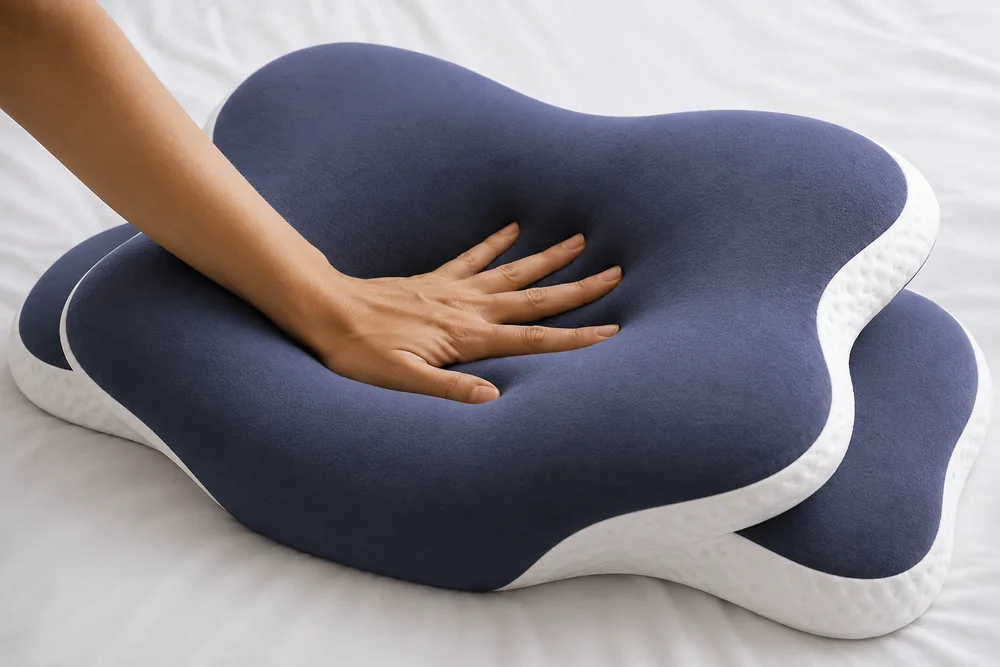
What an ergonomic shape is actually doing
Three decisions, and they all follow from the same measurement: your head and your neck sit at different heights off a mattress, and the difference changes when you roll over.
Material where the neck is. Lie flat with no pillow and slide a hand behind your neck: there is an empty inch or two. A raised edge along the front of the pillow fills it.
Space where the head is. The skull is heavy and needs the least. A lower area behind the raised edge lets it settle rather than being propped.
A second height for a second position. On your side the gap to fill is the width of your shoulder — often 4 to 6 inches (10–15 cm), roughly double what you need on your back. Two edges of different heights let one object serve both, and switching means turning it over.
None of that is exotic. It is the shape you would arrive at if you measured a sleeping person and cut foam to match, which is precisely what ergonomics means.
Judging one yourself
“Ergonomic” is not a certified term — no test is passed before it goes on a box. That is a reason to check rather than a reason to worry, and checking is quick.
- The line test. Lie the way you sleep, have someone photograph you head-on at bed level, and trace nose → chin → the notch between your collarbones. Straight is right. Head tipping down means too little height; chin toward the ceiling means too much.
- The fist test. Press into the middle and count the return. Three to five seconds is proper viscoelastic foam; instant is not memory foam; still dented after ten seconds means it will not hold a height through a night.
- The side-on photograph. Look for two distinct heights and a visible raised edge. A flat silhouette is a flat pillow with a shaped description.
Those three take under two minutes together and tell you more than the entire front of the packaging. The full version of the line test covers what to do with the result.
Fit beats specification
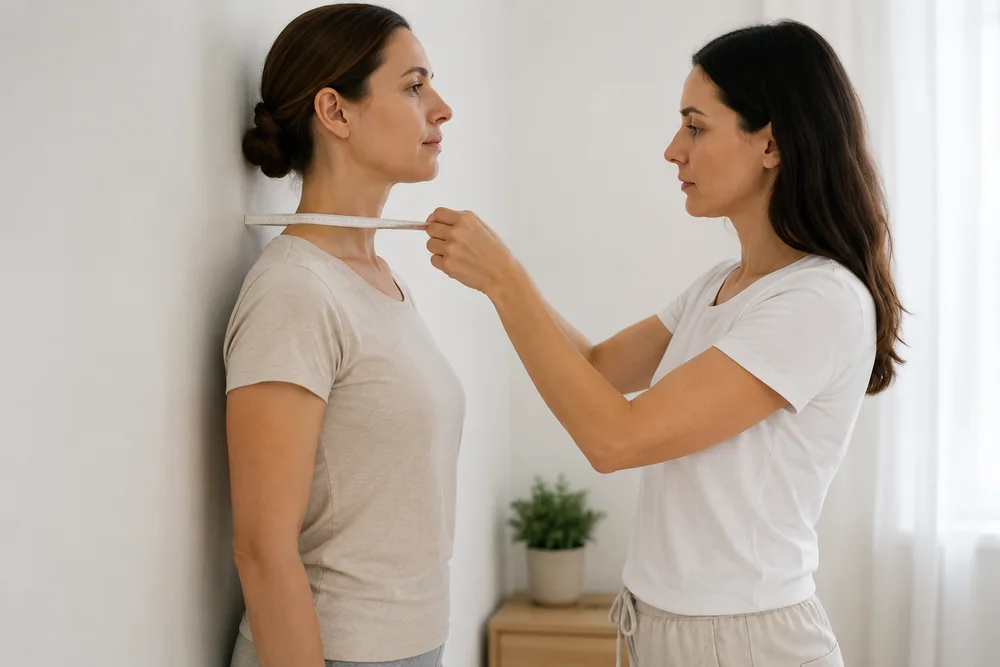
The center of this subject: an ergonomic pillow is a good pillow for a particular body. Shoulder width sets the height you need, and shoulder widths differ by several inches between adults. The same well-made pillow is correct for one person and two inches too low for another.
That is why the most useful thing on this page is a measurement rather than a recommendation. Work out your own gap first; the choice becomes obvious afterwards. And if you sleep in more than one position — most people do, without noticing — the two-height design exists precisely so that the answer does not have to be a compromise between them.
The first three weeks
A neck held at one angle for years takes two to three weeks to settle into another. During that time a little morning stiffness is common — muscles that were working one way are reorganizing — and it improves week on week. A wrong height does the reverse: it stays flat or gets worse. That direction of travel is the signal to read, and it takes two weeks to see.
Memory foam adds one more thing to expect on night one: it is stiff at room temperature and reaches working softness at skin temperature after two to five minutes. Lying down on something that feels too hard and having it give way underneath you is how the material behaves — the memory foam page covers why.
Common questions about ergonomic pillows
How ergonomic pillows really work
An ergonomic pillow works when its shape matches the body lying on it — which means the answer depends on your build as much as on the pillow. Get the height right for your shoulder width and the foam dense enough to hold it, and your neck stays in line for seven hours instead of being bent. That is testable on yourself in thirty seconds with the line test.
What are ergonomic pillows good for?
Holding one position well for a long time. A day at a desk is a problem of movement — you shift, stand up, stretch. A night is the opposite: you hold roughly four positions for around two hours each, and whatever angle your neck is set at, it stays there. A shaped pillow is aimed squarely at that second problem.
Are ergonomic pillows better for you?
Better than a pillow that has flattened, almost always. Better than a good pillow at the right height for you, not necessarily — the shape is a way of getting the right height in two positions rather than one. The measure that matters is whether your neck stays in line, not what the product is called.
What is the best ergonomic pillow for sleeping?
The one that fits you, which is a real answer rather than a dodge: shoulder width sets the height, and the height is what decides everything else. Beyond that, high-density foam that returns in three to five seconds, two heights if you change position at night, and a cover that unzips for washing.