
Neck roll pillow: what the cylinder is holding up
It is the least understood shape in the category, partly because the name describes the object rather than the job. Here is the gap it fills, how to know if the size is right for you, and why the built-in version behaves differently at four in the morning.
Find the gap with your own hand
This takes ten seconds and it explains the whole shape. Lie flat on your back on a bare mattress, no pillow. Now slide a hand behind your neck.
There is a space there, an inch or two deep, and nothing is in it. Your skull is resting on the mattress; your shoulders are resting on the mattress; the curve between them is unsupported and the muscles along it are holding your head in place instead of resting. That gap is the entire reason the neck roll exists.
Now put an ordinary pillow under your head and feel again. The gap is still there — in fact it is often bigger, because the pillow has lifted your skull and opened the arch further. This is the part people find counter-intuitive: a thicker pillow does not fill the space behind your neck, it enlarges it.
Getting the diameter right
A roll that is the wrong size is worse than no roll, and the failure is easy to spot from the outside.
- Too small and nothing changes: the cylinder sits in the arch without touching it and the neck muscles keep working. You will feel no difference at all, which is how most people conclude that neck rolls do not work.
- Too big and your head is levered backward or your chin is driven toward your chest, depending on where it sits. Either is worse than the flat pillow you started from.
- Right means the arch is filled and your chin stays level — neither pointing at the ceiling nor tucked down. From the side, nose, chin and the notch between your collarbones fall on one straight line.
Most adult arches want something in the region of 3 to 4 inches (8–10 cm) of support at the deepest point, but the range is wide and you should measure rather than assume. The line test settles it in thirty seconds and needs nothing but a phone.
The problem with a roll that is not attached to anything
Here is what does not show up in a product photograph: what the object is doing at four in the morning.
A loose cylinder is a separate item lying on a smooth surface, under the heaviest part of a body that moves twenty to forty times a night. It rolls. It ends up under the shoulder blades, or against the headboard, or on the floor. People wake up, put it back, and after two weeks it lives in a cupboard. This is by far the most common reason a neck roll gets abandoned, and it has nothing to do with whether the support was right.
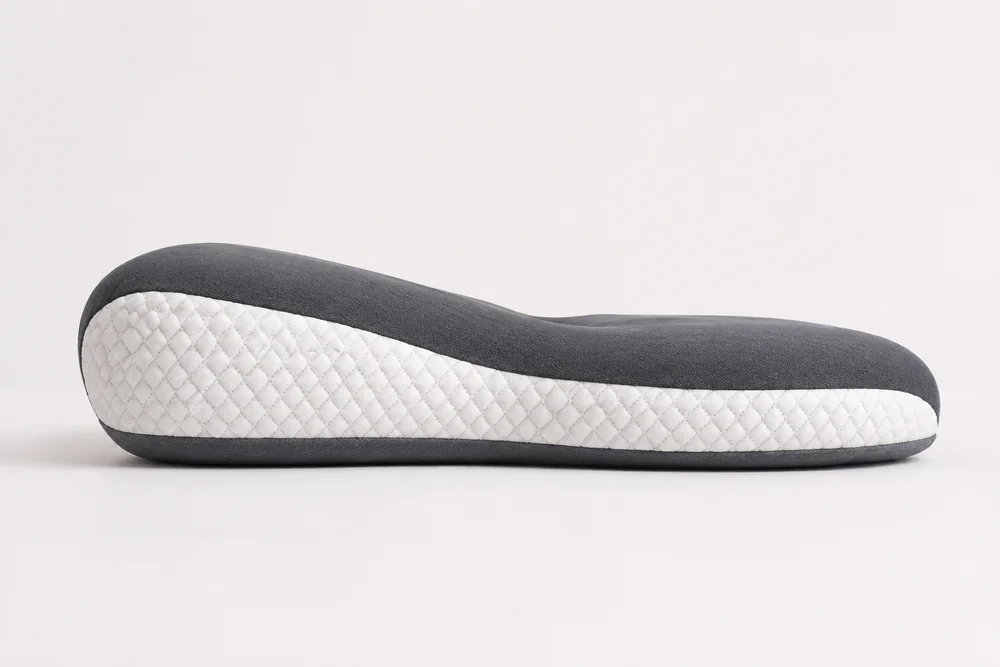
A roll built into the front edge of the pillow cannot go anywhere. It is the same cylinder, in the same place, doing the same job — it is simply part of the object your head is already on. That is the whole design argument for a contour pillow with a raised bolster, and it is a practical argument rather than a clever one.
Two ways to lie on one
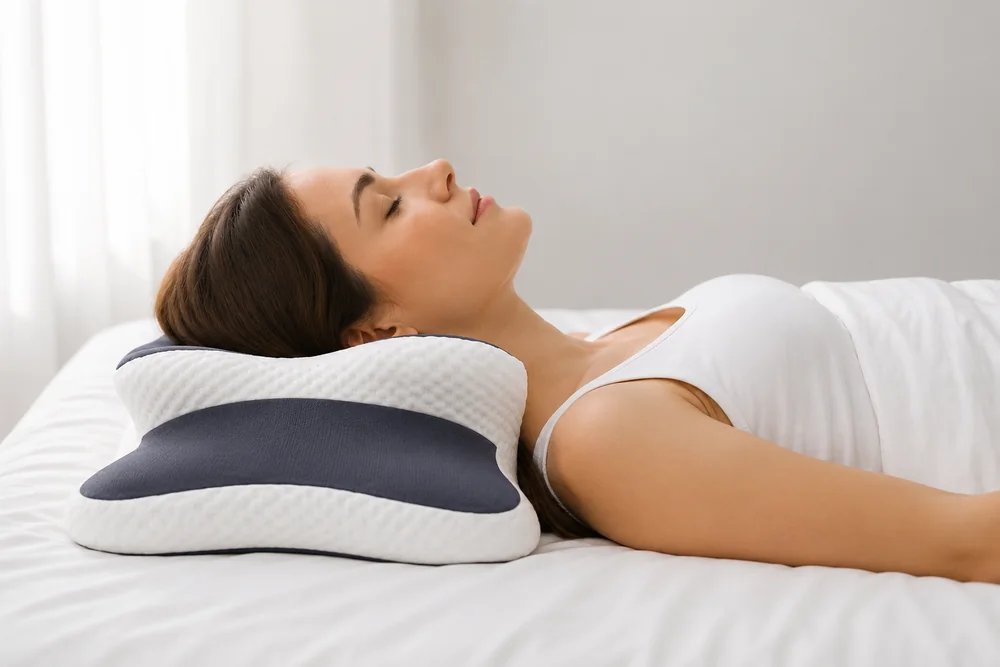
On your back — the standard case. The roll goes under the neck, not under the head; the head settles behind it, lower. Your shoulders stay off the pillow entirely. If your chin is pointing upward you are too far down the pillow; slide up an inch.
On your side — the roll does less, and this is worth knowing up front. On your side the gap you are filling is the width of your shoulder, four to six inches, and it needs a height rather than a curve. A pillow with a bolster and a taller region for side sleeping handles both; a bare cylinder handles only the first. If you sleep mostly on your side, height is the thing to check first — the contour page covers how the two heights are meant to be used.
What the roll is responsible for
It does hold the cervical curve in the position it holds when you are standing, for as long as you are lying on it. That is measurable, you can photograph it, and it is the entire claim.
Everything else has its own address. Neck pain comes from somewhere — a mattress that has collapsed in the middle, a desk set two inches too low, an old injury, a bad month. Each of those is fixed where it lives. The roll takes charge of the seven hours you are lying on it, which is genuinely useful and is the whole of what it claims.
The line worth drawing: pain that persists for weeks, that wakes you, or that travels down into the arm belongs with a doctor or a physical therapist. No shape of foam substitutes for a diagnosis.
What to check before buying one
| Check | Why it decides |
|---|---|
| The foam returns in 3–5 seconds | Faster is not viscoelastic; slower means the density is too low and the roll will flatten within months. |
| The roll is fixed, not loose | A separate cylinder migrates during the night. This is the single most common reason they get abandoned. |
| There is a taller region too | A bolster alone does nothing for side sleeping, which is how most people spend part of the night. |
| The cover unzips | Foam can never be machine washed — water destroys the cell structure. A sewn-on cover puts the pillow on a countdown. |
Common questions about neck rolls
What is a neck roll pillow?
A cylinder of foam, usually 4 to 6 inches across, placed under the neck rather than under the head. It exists to fill one specific void: the arch between the back of your neck and the mattress, which an ordinary pillow leaves completely empty. Some are sold loose; on a contour pillow the same roll is built into the front edge.
Is it good to sleep with a neck roll pillow?
It is good to have the arch of your neck supported, which is what the roll does. Two conditions decide whether it works for you: the diameter has to match your own arch — too big and your chin is pushed toward your chest — and it has to still be under your neck in the morning. A loose cylinder migrates; a roll built into the pillow cannot.
Are neck roll pillows good for you?
For holding the cervical curve while you lie on your back, yes, and the reason is geometric rather than medical. What they are not is a treatment: neck pain has causes a pillow does not touch — a mattress that has given way, hours at a desk, an injury. A roll can stop your nights adding to the problem, which is a real thing and not the same as a cure.
Which neck roll pillow is best for neck pain?
The one whose height matches the arch you actually have, which you can measure by lying flat on a bare mattress and sliding a hand behind your neck. Beyond that: high-density foam that returns in three to five seconds, and a roll that does not move during the night. Pain that persists, wakes you, or travels down the arm is a matter for a doctor rather than a pillow.