
Firm, medium or soft: how to settle it
This is the question that stalls the most purchases, and it is almost always asked back to front. Here is how to answer it without trying a single pillow.
Firmness is not a matter of taste
Almost everyone picks a pillow the way they pick a mattress in a showroom: pressing it with one hand, standing up, for about four seconds. That tells you nothing about eight hours lying down, with the weight of a head — around 11 lb (5 kg) — concentrated on an area the size of a dinner plate.
The only criterion that counts is geometric: head, neck and the top of the spine have to stay in line. Too firm and the head is pushed up; too soft and it sinks until the neck hangs. Either way the neck muscles work all night to compensate, and that work is what you feel in the morning.
What your position dictates
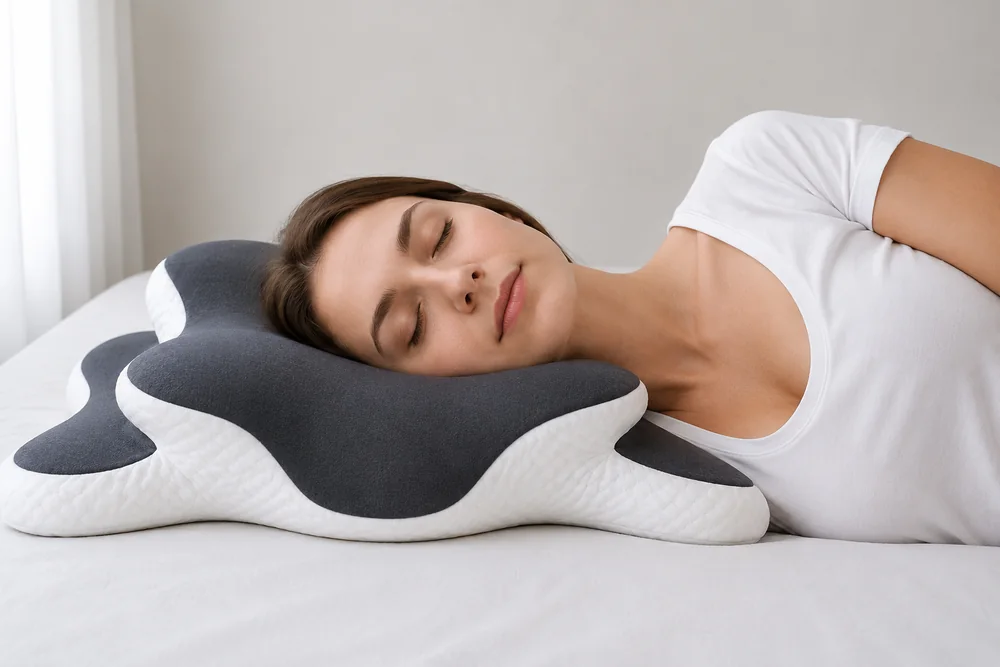
On your side, the gap to fill is the largest of the three: from the mattress to your ear, which is the width of your shoulder — often 4 to 6 inches (10–15 cm). You need firmness, or the pillow collapses and the head tips downward.
On your back, the gap drops to an inch or two. The same pillow is now too high: the chin moves toward the chest and the neck bends forward. You need less height, but still support under the curve of the neck.
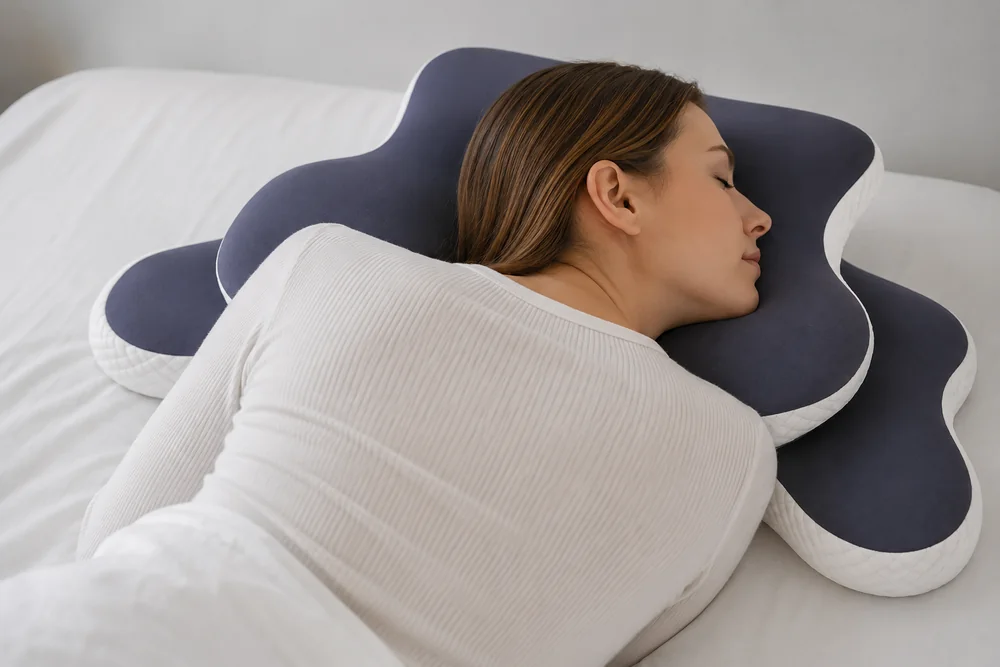
On your front, your head is turned sideways and the neck is already rotated. Any extra height increases the twist. This is the one position where a very flat pillow — or none at all — is the better answer.
Your build changes the answer
In the same position, two people do not need the same height. Broad shoulders push the ear further from the mattress, so more height is needed. Someone slighter, sleeping the same way, ends up with their head propped up on that very pillow.
Which is why blanket advice like “get a firm pillow if you sleep on your side” falls short. The useful version is: get a height that fills your shoulder-to-ear gap, and enough firmness that the height is still there at six in the morning.
The test that settles it, in thirty seconds
Lie down the way you normally sleep and have someone photograph you head-on, at bed level. On the photo, draw a line in your head from your nose, through your chin, to the notch between your collarbones. It should be straight.
If the head tips toward the mattress, there is not enough height or not enough firmness. If it is pushed up, there is too much. Repeat it on your back: the chin should neither point at the ceiling nor touch the chest. Thirty seconds, and it replaces every showroom test you could do.
Sleepers who move around all night
That is most people, and it is what makes the choice look impossible: the firmness that is right on your side is too much on your back. Stacking a second pillow in the middle of the night is not an answer — nobody wakes up to do it.
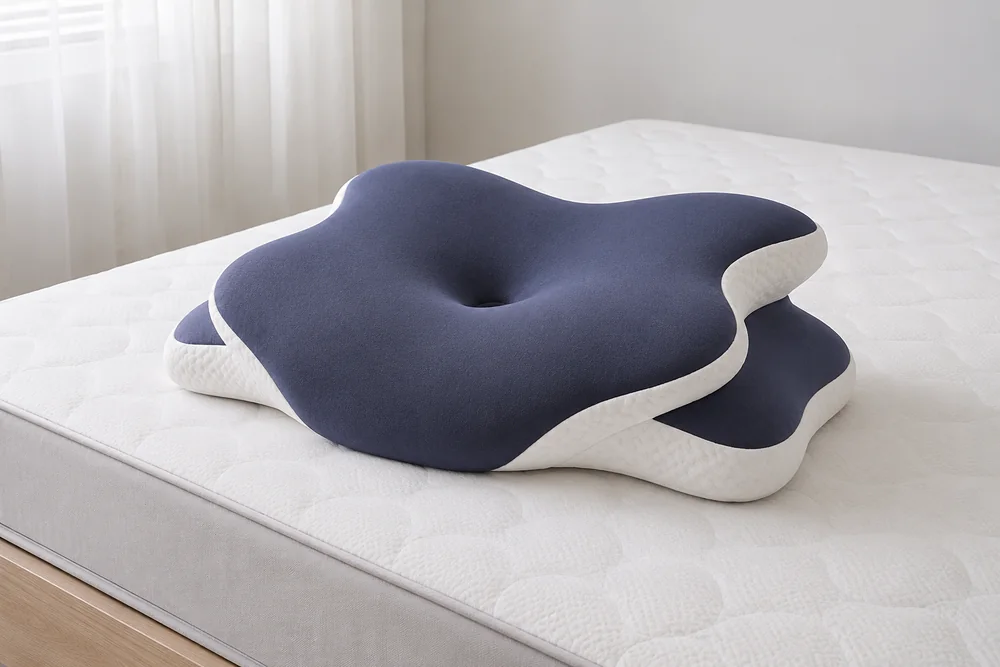
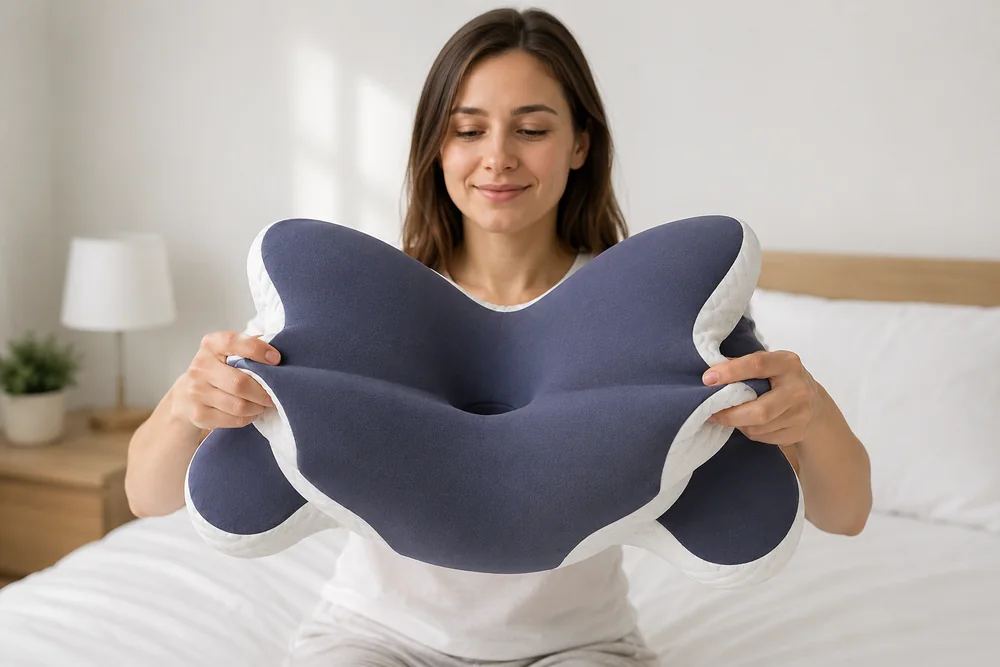
The simplest answer is a pillow built with two profiles — one side hollowed, one side full — that you turn over as needed. Nothing to adjust, nothing to add: the height changes because the object is the other way up. That is how ours is built, and it is what buyers describe unprompted when they compare the two sides.
Firm on contact, soft a few minutes later
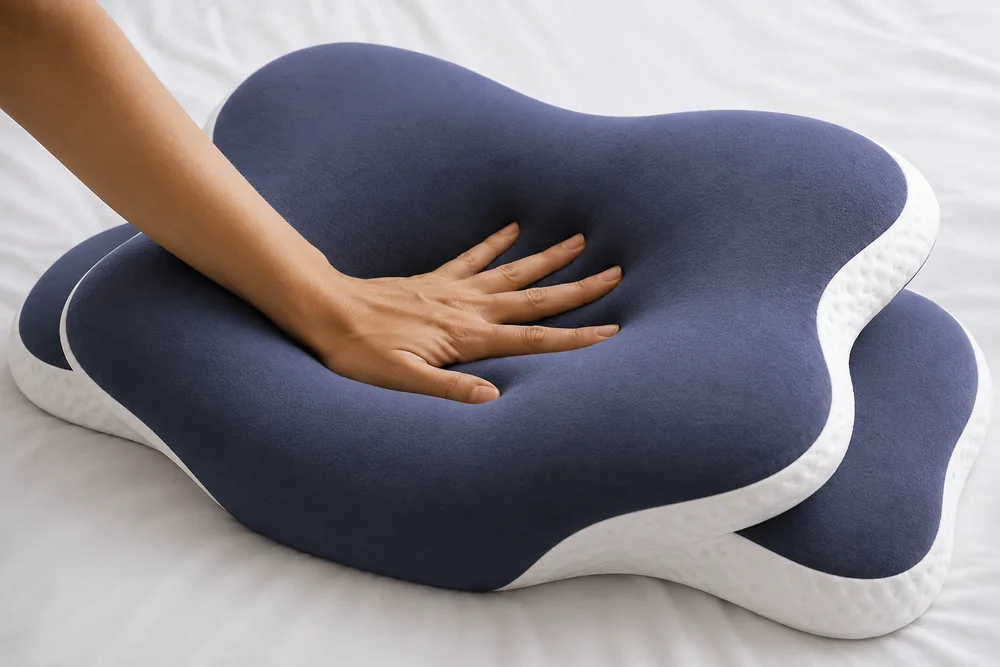
A memory foam pillow feels hard when you press it with your hand, and that is what makes people hesitate in a store. The sensation changes once your head is on it.
The reason is thermal: viscoelastic foam softens with body heat. For the first few minutes it resists; then it takes the shape and the hardness goes. It is the delay that throws people — you are judging in three seconds a material that answers in three minutes.
Two practical consequences. In winter, in a cool bedroom, the pillow is firmer for the first few nights — normal, and it settles. And the hand test in a store tells you close to nothing about what you will feel at night.
Why hotel pillows feel wonderful and leave you stiff
“What firmness are most hotel pillows?” is one of the questions people actually type, and it is worth answering because the hotel pillow is the reference point most of us have.
Soft to medium, almost always — and chosen that way deliberately. A hotel buys one pillow for every guest who will ever lie on it: side sleepers, back sleepers, a child, someone twice their weight. Soft offends nobody. It also photographs well, piles high, and plumps back up in ten seconds for the next room turnaround. Every one of those is a reason that has nothing to do with a neck.
So the pillow that felt like a cloud for twenty seconds is the same pillow you woke up stiff on. It was never picked to hold anything up. That is the difference between a pillow chosen for the first impression and one chosen for the seventh hour.
Firm or plush: what each word actually covers
The two words get used for two different things, and that is why reviews contradict each other.
Surface feel is what your hand or your cheek registers straight away. It comes from the cover, the pillowcase, and the density of the first fraction of an inch.
Load-bearing is whether it keeps its height with 9 to 11 lb (4–5 kg) on it for seven hours. That is what decides where your neck sits, and that is the one that counts.
A pillow can be soft on the surface and hold its load perfectly — that is the combination you want. A filling that feels beautifully lofty in the shop can flatten completely once a head is on it. When one person writes “too hard” and another writes “so comfortable” about the same product, they are not talking about the same thing.
What to take from that when choosing: judge the load-bearing, not the surface feel. Surface feel is fixed by a pillowcase; load-bearing is not fixed by anything.
The break-in period, and how to tell it from a wrong choice
Two to three weeks. That is how long a neck used to another angle for years takes to adjust, and it is the number nobody gives you at the point of sale.
During that time a little morning stiffness is common: the neck muscles were working one way and are reorganizing. Not pleasant, but going the right way.
The signal that separates adjustment from error is the direction of travel. Adjustment improves week on week. A wrong height gets worse or stays put. If week three is clearly worse than week one, this is not a matter of getting used to it: redo the line test, and flip the pillow onto its other side.
Common questions about firmness
Is it better to have a firm or soft pillow?
Neither, in the abstract. What matters is that your neck stays in line with your spine. A side sleeper needs firmness to fill the gap between shoulder and ear; a front sleeper needs the opposite. The position decides, not the preference.
What happens if your pillow is too firm?
Lie on your back and look at your chin. If it points at the ceiling, the pillow is too thick or too firm. The other sign shows up in the morning: a stiffness that wears off during the day. Your neck spent the night pushed out of line and the muscles worked to compensate.
Is it better to have a thicker or thinner pillow?
It follows your shoulder width, not your build in general. On your side you are filling the distance from the mattress to your ear — often 4 to 6 inches (10–15 cm). On your back that drops to an inch or two. The same pillow cannot be right for both unless it offers two heights.
Do pillows get less firm over time?
A fiber filling does: it packs down and loses its firmness within months. High-density memory foam does not — it softens with body heat each night and firms up again once you get out of bed. That is a difference of kind between the two families, not of degree.
What firmness are most hotel pillows?
Soft to medium, and chosen that way on purpose: a hotel buys for every guest at once, and for how the bed photographs. It is a plush pillow, not a supportive one — which is why plenty of people wake up in a nice hotel with a stiff neck.
Do I need a different pillow if I move around at night?
Most sleepers switch position without noticing. A pillow with two sides at different heights settles it without you having to choose: you flip it over for the position you are in.