
· Nora Fenwick
Sleeping on a long-haul flight
Decide before you board: sleeping flight or waking flight?
This is the whole strategy, and it takes thirty seconds at the gate.
If it is night where you are going for most of the flight, this is a sleeping flight. Eat early or skip the meal, get dark and quiet as soon as the service is over, and protect the block.
If it is daytime where you are going, this is a waking flight. A long sleep here lands you wide awake at 2 a.m. local, which is the thing that ruins the first two days. Short naps only, and keep the cabin light on you.
The direction usually decides it. Eastbound overnight flights are sleeping flights and they are short on sleep opportunity, so every hour counts. Westbound daytime flights are waking flights, and the temptation to sleep is strongest exactly when it costs most.
The first two hours are spent, not slept
Boarding, taxi, climb, drinks, meal. On most long-haul flights the first ninety minutes to two hours are not available whatever you intend, and people who try to sleep through the service end up woken twice and irritated.
Use them: change into something you can sleep in, set your watch, drink water, and get the seat and the pillow arranged before the lights go down rather than after. Recline as soon as the belt sign goes off — cabin crew ask you upright during service, and the window for it is earlier than most people realize.
The block in the middle
Aim for one long block rather than several short ones. Sleep on a plane is fragmented by definition, and every interruption costs more than it does in a bed because getting back down takes longer in a seat.
Protecting the block is mostly about removing interruptions before they happen:
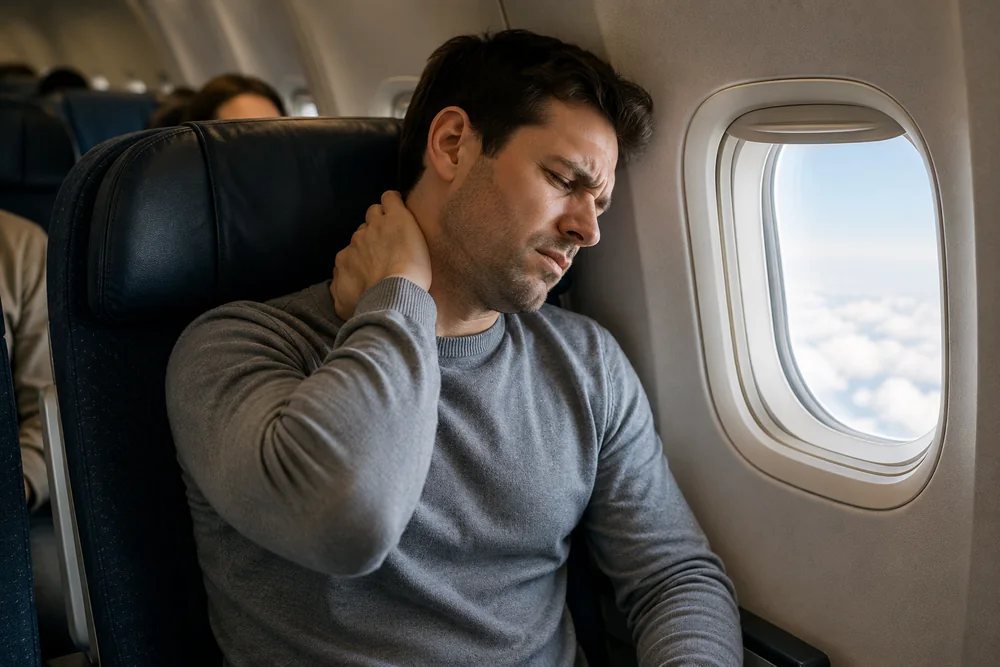
- Head held. The single biggest one. A U-shaped pillow worn with the opening at the front, under the chin, stops the fall-and-catch cycle that surfaces you every few minutes. Which way round, and why.
- Window seat. Something to lean on, and nobody climbing over you two or three times. Which rows to avoid.
- Eye mask and ear protection. Cabins are never dark, and it is the intermittent noise — a chime, a trolley — that wakes you rather than the steady rumble.
- A note for the crew. Most airlines will leave you through a meal if you say so. Some give you a sticker for the headrest.
Getting up, on purpose
Counter-intuitive on a flight you are trying to sleep through, and worth it. Long periods of immobility in a cramped seat carry a circulation risk that is worth taking seriously, and a walk every few hours also resets the pressure points that would otherwise wake you anyway.
Ankle circles and calf raises in the seat are the minimum. A slow walk to the back and back is better. Neither will cost you the block if you are not fully awake when you do it.
What tends to work against you
| Why it usually costs more than it gives | |
|---|---|
| Alcohol | Shortens the time to fall asleep and fragments what follows. Cabin air is already dehydrating. |
| Coffee at the gate | Caffeine has a half-life of around five hours. It is still working when you wanted to be down. |
| The big meal | Eating in the middle of your destination's night is a signal in the wrong direction. Eating before boarding gives you the choice. |
| Sleeping tablets or melatonin | Anything that keeps you immobile for hours in a seat is a conversation with a doctor before the trip — not a decision at 35,000 feet. |
The last two hours
Stop sleeping before the cabin lights come up, not when they do. Waking to a service trolley and bright light is a bad way to start a day you are about to have to function in.
Open the blind if it is daylight at the destination — light is the strongest signal your body clock has, and getting it in the air rather than in a taxi is worth an hour or two of adjustment. Water, a walk, and something to eat if it is breakfast time where you are landing.
Arriving
Stay up until a normal local bedtime, and get outside in daylight if there is any. Both are more effective than anything you can do on the plane, and both are easier if you got the timing right in the air.
If you land with a stiff neck, that is usually a sign the head was traveling all night rather than being held — what to do about it, and what it means for the return leg.