· Nora Fenwick
The best airplane seat for sleeping
Choosing the seat is the one decision you make before boarding that changes how the whole flight goes. Here is what each factor is actually worth.
Window, every time
Two reasons, and the second is the bigger one.
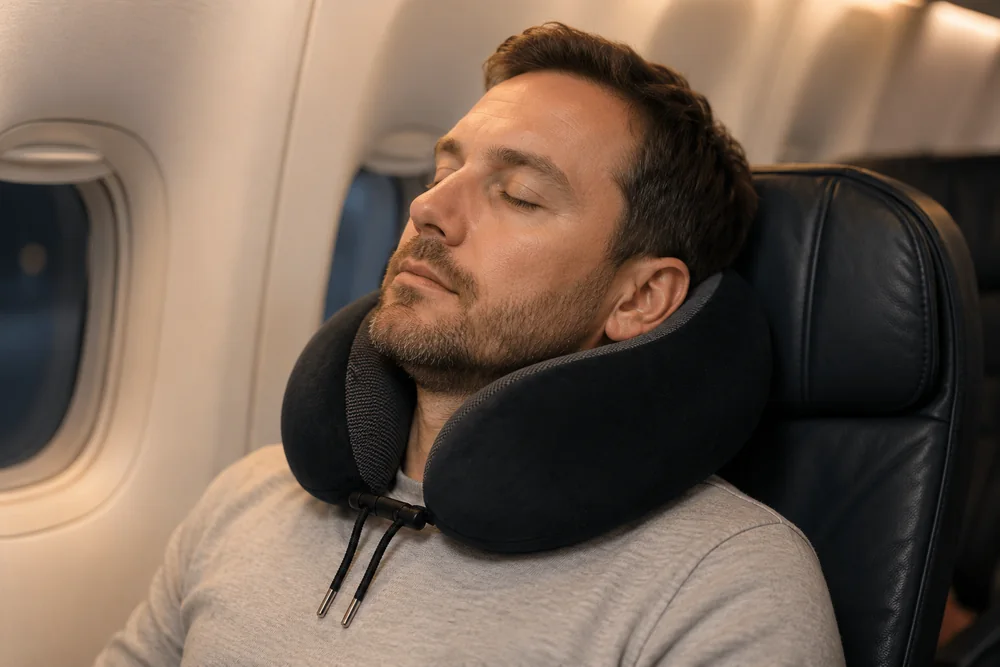
You have something to lean on. Sitting upright, your head has to be held by something. A fuselage wall on one side turns an unstable balance into a stable lean. Combine it with a neck pillow bridging the gap and the head stops traveling altogether.
Nobody needs to get past you. On a long-haul, the person in the window seat gets up two or three times. In an aisle seat you are woken by every one of them, plus the trolley, plus everyone walking to the toilet. An aisle seat is the right choice if you want to move; it is the wrong one if you want to be unconscious.
Forward of the wing
The engines are mounted on the wing, and the noise behind them is meaningfully louder than the noise in front. Sitting ahead of the wing puts the engines behind you.
Very front rows are the quietest, but the bulkhead comes with its own problem — see below. A few rows ahead of the leading edge of the wing is the practical sweet spot.
The rows to avoid
| Row | What is wrong with it |
|---|---|
| Last row | Often does not recline at all, and backs onto the rear galley and toilets — light and traffic all night. |
| Row in front of an exit row | Frequently has limited recline for evacuation clearance. It looks like an ordinary seat on the map. |
| Exit row itself | More legroom, colder, armrests often fixed, and on many aircraft the seat itself does not recline. |
| Bulkhead | No seat in front to recline into your space — but also no under-seat storage, fixed armrests, and this is where bassinets go. |
| Beside a galley or toilet | The lights stay on, the doors bang, and there is a queue standing next to your head for most of the night. |
Which side of the aircraft
On an overnight eastbound flight, the sun comes up on your left. If you want to stay asleep through the sunrise, the right-hand side of the aircraft keeps it out of your window for longer. It is a small thing, and on a short overnight it is the difference between waking at the sunrise and waking at the landing announcement.
The two-seat trick
On aircraft with a 2-4-2 or 2-3-2 layout, the pairs at the sides are worth more than they look: one neighbor instead of two, a window, and no one climbing past. On a 3-3-3 wide-body, the window seats in the side blocks are the equivalent.
If you are traveling as a pair on a three-seat block, booking the window and the aisle and leaving the middle empty is a well-known gamble. It works on a flight that does not fill; when it does fill, you get a stranger between you and you can usually swap.
The seat sets the interruptions, the pillow sets the sleep
A perfect seat still leaves your head unsupported, because that is a property of sitting upright rather than of the seat. The seat decides how much interruption you get; the pillow decides whether you fall asleep between interruptions.
Get the seat right and then wear the pillow right — opening at the front, under the chin, which is the opposite of how most people wear it. The method is here, and what else helps covers the light, the noise and the timing.