
Contour pillow: what the profile changes
“Contour” is the most useful of the pillow words because it describes a measurable thing. Here is what the profile does, which side to start on, and how to know within three weeks whether you chose right.
Look at it from the side, not from above
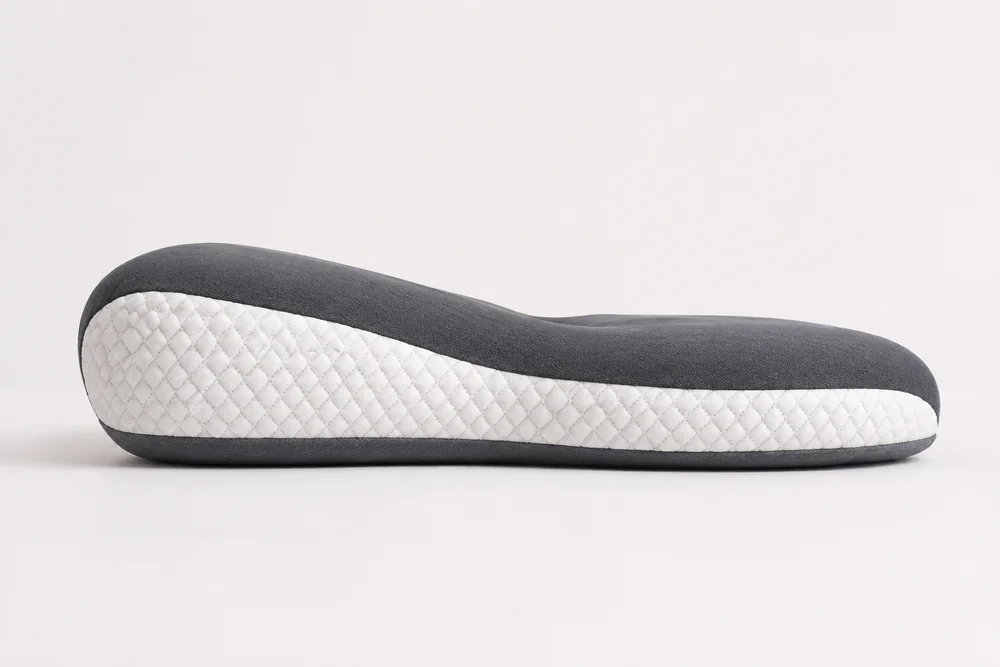
Photographs of these pillows are almost always taken from above, which is the one angle that hides what you are paying for. Turn the picture ninety degrees and the profile appears: a wave, with a crest along the front edge and a trough behind it.
That wave exists because your head and your neck are not the same height off the mattress. Lie flat on a bare mattress and slide a hand behind your neck: there is a gap of an inch or two, and it is empty. Your skull, meanwhile, is resting on the mattress and needs nothing under it. A flat pillow gets this exactly backwards — it puts its full thickness under the part that needs least, and nothing extra under the part that needs most.
The crest of the contour fills the gap. The trough gives the skull somewhere to settle. That is the whole idea, and it is why the shape looks strange the first time you see one.
Two heights on one object
The second feature is the one that decides whether the pillow suits you, and it is rarely explained: the two long edges are not the same height. One crest is lower, one is higher. Flip the pillow front-to-back and you have a different pillow.
The reason is the gap you are filling, which changes with position:
| Position | Gap from mattress to head | Which side |
|---|---|---|
| On your back | An inch or two — the arch of the neck only | The lower crest |
| On your side | 4 to 6 inches (10–15 cm) — the width of your shoulder | The higher crest |
| On your front | Effectively none; the neck is already turned | Neither — flat is better |
Most people sleep in more than one of these over a night without knowing it, which is precisely the problem a two-height pillow solves: the height changes because the object is the other way up, and that takes a second, not a decision.
Should side sleepers use one?
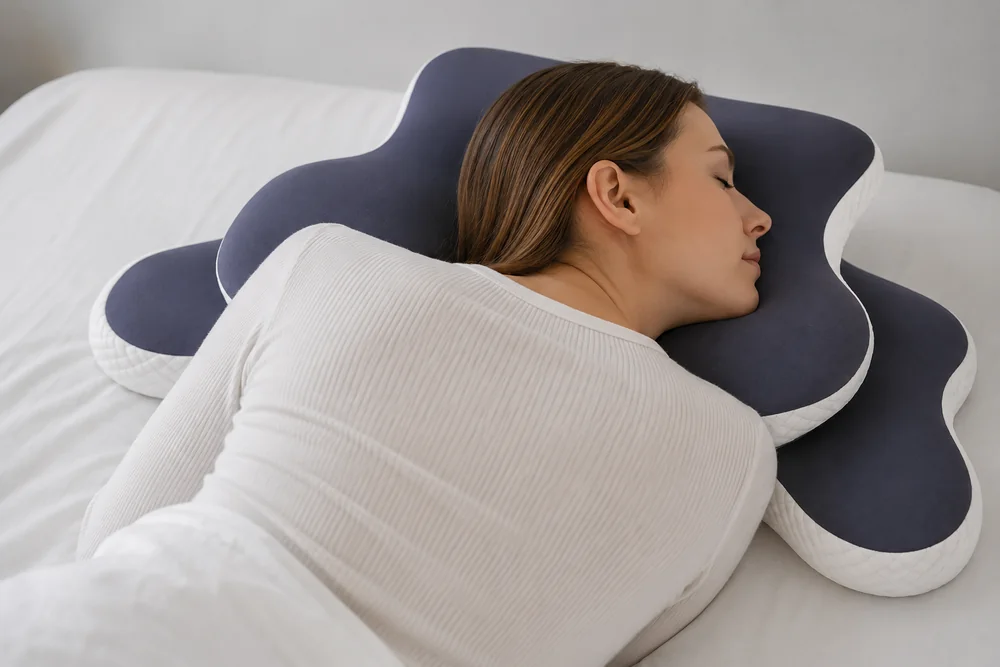
Yes — and side sleepers get more out of a contour profile than anyone, because they have the largest gap to fill and the least tolerance for getting it wrong. A head that drops toward the mattress all night bends the neck sideways for seven hours.
But the answer comes with a condition that is worth stating up front rather than after delivery. A contour pillow whose higher side is still too low for your shoulders is worse for you than a thick soft pillow, because it will not compress much and it will not gain height. Firmness is an advantage only once the height is right; below that, it is just a hard surface at the wrong altitude.
Broad shoulders need more. If you are unusually broad and the higher crest still leaves your head tipping down, the fix is not a firmer pillow — it is a taller one. That is a measurement, and the line test gives it to you in half a minute.
How they actually work
This is the question people type, and it deserves the version of the answer that can be checked rather than the version that sells.
What a contour profile does: it keeps the head, neck and top of the spine in a straight line, and it keeps them there at three in the morning as well as at lights-out — provided the foam does not pack down. That is the claim, it is geometric, and you can photograph yourself and see whether it is true for you.
The rest of the day counts too. Neck pain has causes that sit outside the bed — a mattress that has given way, hours at a desk, an injury. Those are handled where they arise. A pillow governs the seven hours you lie on it, and keeping that stretch in line is a real and useful thing.
The short version: a contour pillow settles one variable for good. If your neck was being bent for seven hours a night, it stops being bent — and that is the change people notice first, usually within two weeks.
The first three weeks
A neck that has been held at one angle for years does not adopt a new one overnight, and this is the piece of information that is missing at the point of sale. Expect two to three weeks.
During that time, some morning stiffness is common: muscles that were working one way are reorganizing. It is not pleasant and it is going the right way. The signal that separates adjustment from a wrong choice is the direction of travel — adjustment improves week on week, a wrong height gets worse or stays flat. If week three is clearly worse than week one, stop waiting it out: redo the line test and turn the pillow onto its other side.
One more thing that catches people out on the first night: memory foam is firm until it warms up. At 65 °F (18 °C) the foam is stiff; it reaches working softness at skin temperature after two to five minutes. Lying down on something that feels too hard, and having it give way underneath you, is the normal behavior of the material — covered in full on the memory foam page.
What separates a good one from a bad one
Three checks, all of which survive contact with a product photograph:
- The foam comes back in three to five seconds. Press a fist in and count. Instant rebound means it is not viscoelastic; an impression still visible after ten seconds means the density is too low or the foam is spent.
- The crest is tall enough to fill an arch. A gentle undulation looks like a contour and behaves like a flat pillow. Compare the crest to the trough in a side-on photograph: the difference should be obvious at a glance.
- The cover unzips. The foam can never go in a washing machine — water gets into the cell structure, the spin cycle tears it, and it will not rise again. If the cover is sewn on, the pillow has a shelf life.
What is worth ignoring: gel panels, bamboo labels, and cooling claims stated without a mechanism. A knitted or mesh cover moves air along the sides, which is a mechanism. Everything else in that category is a word on a box.
Common questions about contour pillows
How contour pillows actually work
For holding your neck in line, yes — and the reason is geometric rather than clever. A flat pillow supports the back of the skull and leaves the arch behind the neck empty; a contour profile fills that arch and lets the skull sit lower. You can verify it on yourself in thirty seconds with the line test, which is more than can be said for most pillow claims.
What is the correct way to sleep on a contour pillow?
The raised edge goes under your neck, not under your head, and your shoulders stay off the pillow entirely. Most contour pillows have two sides of different heights: start on the lower one if you sleep mostly on your back, the higher one if you sleep mostly on your side. Give each side two or three nights before you judge it.
Should side sleepers use a contour pillow?
Yes, provided the height is right — and side sleepers need the most height of anyone, because they are filling the gap between mattress and ear, which is the width of their shoulder. A contour pillow whose higher side is still too low for your shoulders will be worse than a thick soft pillow. Measure before you assume: the line test settles it.
Which contour pillow is the best?
The one whose higher side matches your shoulder width, which is a different pillow for a broad-shouldered side sleeper than for someone slight who sleeps on their back. After that, three things separate a good one from a bad one: high-density foam that returns in three to five seconds, a cover that comes off to be washed, and a neck bolster tall enough to actually fill the arch rather than suggest it.