
Butterfly pillow: what the shape is actually for
It is one of the few pillow shapes whose name describes what you can see rather than what it claims to do. Here is what each part is for, how to lie on one, and how to tell a real one from a rectangle with a butterfly printed on the box.
Where the wings come from
Start from the problem. A flat rectangular pillow has one height and one profile everywhere. Lie on your back and it is too thick under the head; roll onto your side and the same pillow is suddenly too thin, because your shoulder has lifted your ear four to six inches off the mattress. Nothing about the object has changed — you have.
The butterfly outline is the simplest answer anyone has found to that. Take away foam where the head sits, and leave it where the head does not: the middle drops, the sides stay high. The result, seen from above, is a shape with a waist and two lobes. It is not styling. Every part of the outline is either a place your head goes or a place it does not.
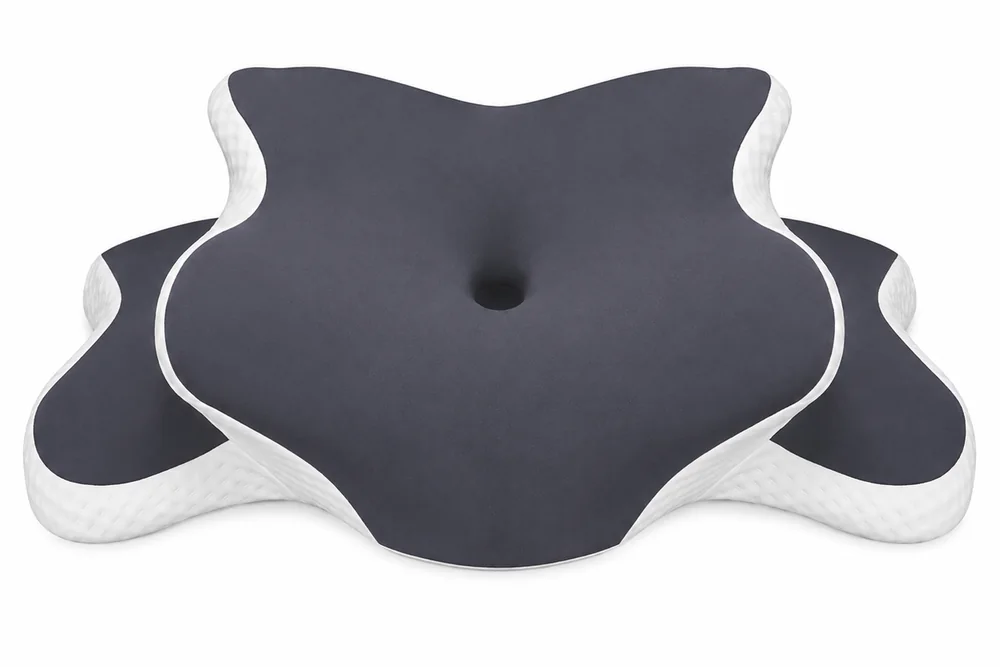
What the two wings actually do
The wings are the part people misread. They are not decorative bumpers and they are not there to stop you falling out of bed. They do two specific things.
They hold the height you need on your side. The gap from mattress to ear, when you lie on your side, is the width of your shoulder — commonly 4 to 6 inches (10–15 cm). That is roughly double what you need on your back. A pillow that is right on your back is wrong on your side unless a taller region exists somewhere on it. On a butterfly pillow, that taller region is the wing, and you reach it by simply rolling — no adjusting, no stacking, no waking up.
They leave a place for your arm. Most side sleepers push one arm under or in front of the pillow. On a rectangle, that arm lifts the whole pillow and takes the head with it. The notch between wing and center gives the arm somewhere to go without moving the surface your head is resting on.
The hollow and the bolster: the two parts nobody photographs
The wings get the name, but the two features that decide whether the pillow works are in the middle.
The central hollow is a dish, not a dent. Its job is to stop the head migrating. On a flat pillow the skull, which is the heaviest thing on the bed, slowly slides toward whichever side is lower — and once it has, the neck is twisted for the rest of the night. A hollow deep enough to matter keeps the head where you put it.
The neck bolster is the raised lip along the front edge. This is the piece that does the actual supporting: it fills the arch behind your neck when you lie on your back, the gap a flat pillow leaves completely empty. Press your fingers behind your neck while lying flat on a mattress and you will feel exactly the void it is shaped to fill.
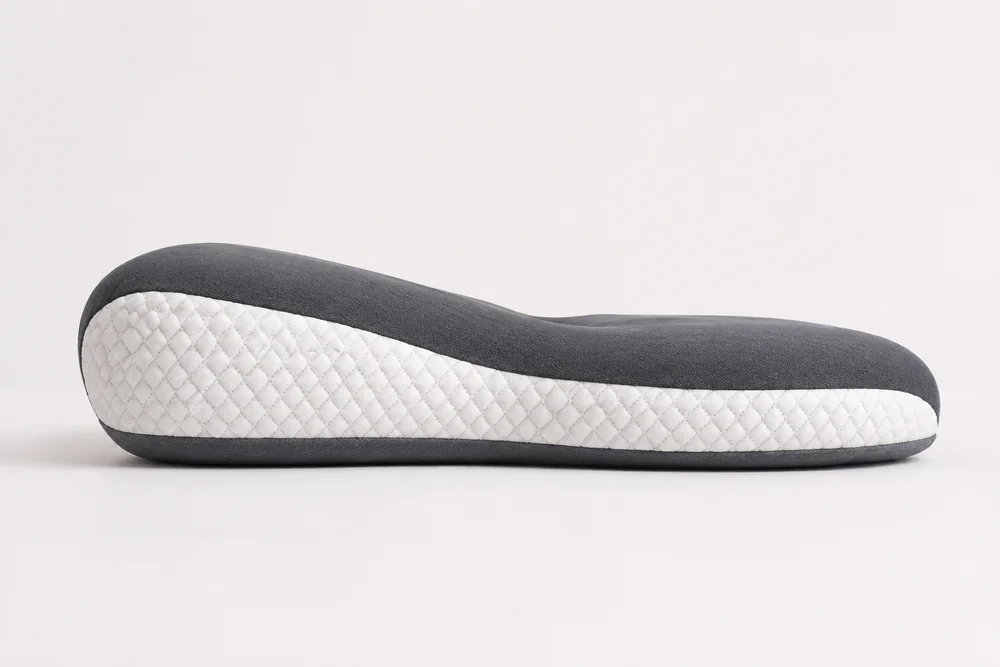
How to lie on one
This is the single most searched question about the shape, and the answer is short enough to test tonight.
- Shoulders off the pillow. The bottom edge meets the top of your shoulders; it does not sit under them. Pushing your shoulders onto the pillow is what creates the chin-to-chest angle people wake up stiff from.
- Neck on the bolster, head in the hollow. On your back, the raised front edge takes the weight of your neck and the back of your skull drops into the dish. If your chin is pointing at the ceiling, you are too far down the pillow.
- Roll onto the wing. On your side, your ear should land on the raised region, not in the hollow. If it lands in the hollow, shuffle across an inch — that is the adjustment, and after a few nights you stop having to think about it.
One thing worth knowing before the first night: most contour shapes have two sides at different heights, and the one that suits you is not obvious in advance. Try the lower side first if you sleep mostly on your back, the higher one if you sleep mostly on your side, and give each two or three nights before deciding. The line test settles it faster than guessing.
Butterfly, contour, cervical: three names, one object
Worth saying plainly, because searching for these terms turns up what looks like three different products. Butterfly describes the outline seen from above. Contour describes the profile seen from the side — the two heights. Cervical describes the part of you it is aimed at. A pillow can easily be all three at once, and the good ones usually are.
The names are not interchangeable in one respect: a pillow can have a contour profile without butterfly wings, and it will then be worse for side sleepers with an arm to park. If you want the detail on the profile, that is on the contour pillow page; on the material itself, the memory foam page.
Snoring: where a pillow comes into it
“Do butterfly pillows stop snoring?” is asked often enough to appear under the search results, so it deserves a straight answer rather than a hint.
No pillow stops snoring. What is true is narrower and worth knowing: snoring is usually worse flat on the back, because the airway is more easily obstructed in that position. A pillow that makes side sleeping genuinely comfortable makes it more likely you stay on your side — and some people notice a difference for that reason alone. That is a consequence of comfort, not a mechanism, and it will not be true for everyone.
What matters more than any of that: snoring that is loud, that breaks off into pauses, or that leaves you exhausted despite a full night is worth raising with a doctor. Sleep apnea is diagnosed, not cushioned.
How to tell a real one from a printed outline
The shape has become a selling point, which means it now appears on products that do not have it. Four checks, all of which you can do from photographs before buying:
| Check | What a real one looks like |
|---|---|
| Seen from the side | Two distinct heights, with a visible lip along one long edge. A flat silhouette means a flat pillow. |
| Depth of the hollow | Deep enough that the head sits in it, not on it. A shallow scoop looks the part and does nothing. |
| Height of the wings | Tall enough to fill a shoulder gap. If they are barely above the hollow, side sleeping is unchanged. |
| The cover | Comes off by a zip. Foam never goes in a machine, so a sewn-on cover puts the whole pillow on a countdown. |
The last one is the one people skip and regret. A memory foam core cannot be washed — water destroys the cell structure and it never springs back. If the cover cannot be removed, the pillow has an expiry date measured in months, whatever its shape.
Common questions about butterfly pillows
What is the correct way to sleep on a butterfly pillow?
Head in the central hollow, neck resting on the raised bolster at the front edge, shoulders at the edge of the pillow and not on it. The two wings sit either side of your head — they are there for when you roll onto your side, and for the arm that ends up under the pillow. If you wake up on the wing rather than in the hollow, the pillow is too small for the way you move, not the wrong way round.
How the butterfly pillow works
For the thing it is shaped to do, yes: it keeps the head from sliding off center and leaves the neck supported when you turn. That is geometry, and you can check it on yourself in thirty seconds with the line test. It is not a treatment, and a pillow shape does not fix a mattress that is wrong for you.
Do butterfly pillows stop snoring?
No pillow stops snoring, and anyone telling you otherwise is selling something. Position plays a part — snoring is often worse flat on the back — so a pillow that makes side sleeping comfortable can change how much you snore. That is a side effect of comfort, not a treatment. Snoring that is loud, broken by pauses, or leaves you exhausted is a matter for a doctor.
Which butterfly pillow is best in the UK?
Judge it on four things you can check rather than on a brand: the height of the neck bolster (it should fill the gap between mattress and neck when you lie on your back), the depth of the central hollow, whether the wings are tall enough to be useful on your side, and whether the cover comes off to be washed. A butterfly outline stamped into a flat rectangle gives you the look and none of the function.