
Side sleeper pillow: it comes down to one measurement
Side sleeping is the most common position and the least forgiving one. Here is how to measure your own gap, what to do with the arm, and how to check the result rather than hope.
Why side sleepers have the hardest job
Lie on your back and the gap you need to fill is the arch behind your neck: an inch or two. Lie on your front and there is effectively no gap at all — the head is turned and already at mattress level. Roll onto your side and your shoulder becomes a column that holds your whole upper body off the bed, and your ear is suddenly four to six inches up in the air.
The same pillow cannot be correct in all three. That is not a manufacturing failure, it is arithmetic — and it is why a pillow that suits you perfectly on your back can leave you with a stiff neck when you spend a night on your side.
The consequence of getting it wrong is also larger on your side than anywhere else. On your back a wrong height bends the neck forward or back, in the plane it is used to. On your side it bends it sideways, which is the direction with the least range, for seven hours.
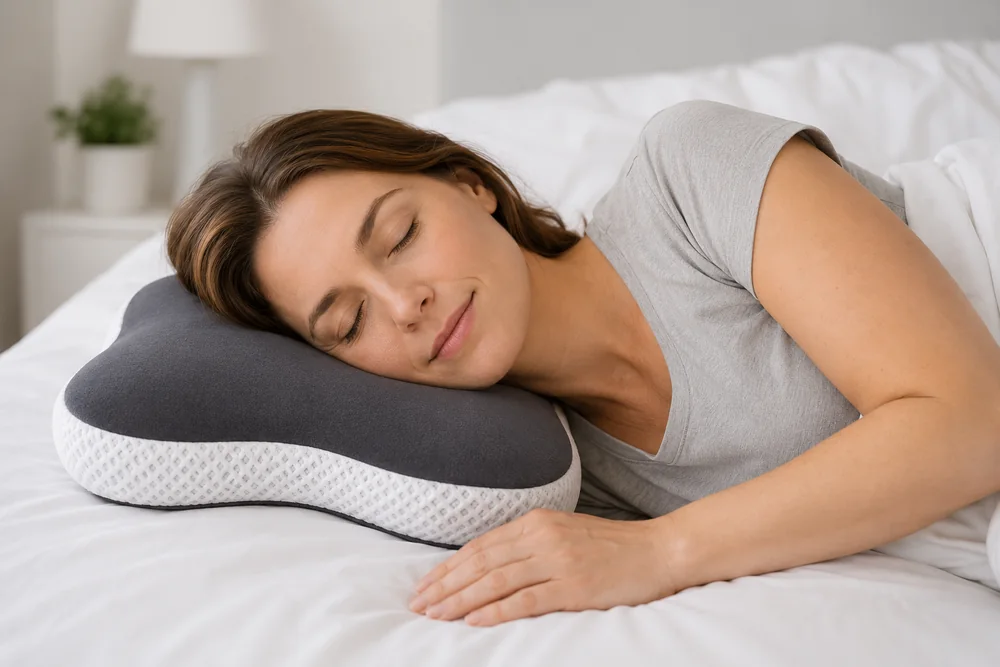
Measuring your own gap
Two ways, and both beat guessing.
Standing, with a wall. Stand with one shoulder against a wall, upper arm relaxed at your side. Measure from the wall to the middle of your ear. That distance is what the pillow has to fill when you lie on that shoulder. Most adults land between 4 and 6 inches; broad-shouldered people go well past that.
Lying down, with a phone. Lie on your side on the pillow you own now. Have someone photograph you head-on, at bed level. Draw a line in your head from your nose, through your chin, to the notch between your collarbones. Straight means the height is right. Head sagging toward the mattress means too low; head propped up means too high.
The second is better because it measures the pillow under load, which is the only condition that matters. And it costs thirty seconds — more on the line test here.
Firmness comes after height, not instead of it
This is the mistake that sends people back for a second wrong pillow. Waking up stiff, they buy something firmer. If the height was the problem, firmer makes it worse.
Height decides where your head sits. Firmness decides whether it stays there. A soft pillow tall enough on paper collapses to nothing under 11 lb of head, so you get the right height for a minute and the wrong one for the rest of the night. A firm pillow that is two inches too low holds you rigidly in the wrong place, which is worse than sagging into roughly the right one.
Get the height first, then ask for enough density to keep it. The test for density needs no instrument: press a fist into the middle and count the return. Three to five seconds is proper viscoelastic foam. Instant means it is not memory foam. Still dented after ten seconds means it will flatten within months.
The arm nobody talks about
Every side sleeper does something with the lower arm, and it is usually one of three things: under the pillow, under the head, or stretched out in front. All three interfere with the pillow, and none of them appear in product descriptions.
- Arm under the pillow. The arm lifts the pillow and takes your head up with it, adding an inch or two of height you did not choose. Then the arm goes numb and you move, and the height changes again.
- Arm under the head. Your own arm becomes part of the pillow, which means the height varies with how you fold it — and the shoulder underneath takes the load.
- Arm in front. The most stable of the three, and the one a shaped pillow can accommodate: a notch between the raised side region and the center gives the arm somewhere to go without moving the surface your head rests on.
That notch is the practical argument for a shaped outline over a rectangle for side sleepers, and it is described in full on the butterfly pillow page.
Shoulder pain and the pillow
Side sleepers who wake with a sore shoulder often look at the mattress first. The pillow is worth checking before that, because it is cheaper to change and it acts on the same joint.
When the pillow is too low, the head drops toward the mattress. That does two things at once: it bends the neck sideways, and it shifts more of the upper-body load down through the shoulder that is already carrying you. Raising the head to level redistributes it.
A second thing that helps: a pillow between the knees keeps the hips stacked, which stops the upper body rotating forward and dragging weight onto the leading shoulder. Shoulder pain that persists for weeks or wakes you regularly belongs with a doctor or a physical therapist — a pillow governs the hours you lie on it.
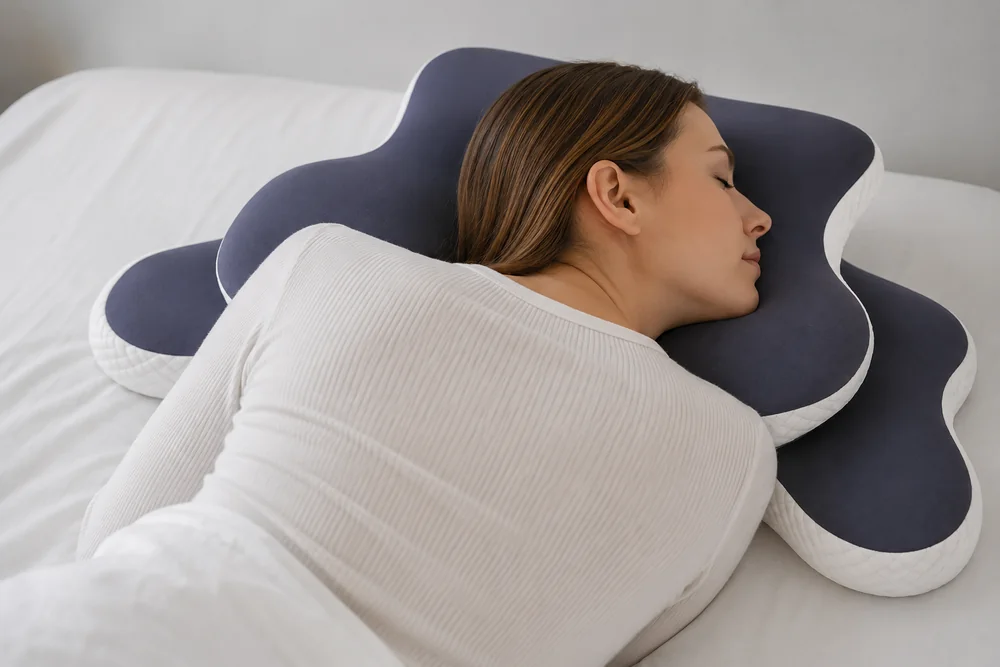
If you do not stay on your side all night
Almost nobody does. The typical night is a few positions held for a couple of hours each, and the height that is right on your side is too much on your back — the chin gets driven toward the chest.
Two heights on one pillow answers this without asking you to decide: the taller side for side sleeping, the lower for your back, and you turn the object over. It takes a second and there is nothing to adjust. Which side to start on, and how long to give each, is on the contour pillow page.
Still comparing models rather than measuring? What actually separates one side-sleeper pillow from another takes the question apart on its own terms.
Common questions from side sleepers
How side sleeper pillows really work
They work when the height matches your shoulder, and they do nothing when it does not — which is why the same pillow gets glowing and furious reviews. On your side you are filling the distance from mattress to ear, commonly 4 to 6 inches. Measure yours before choosing, and the question answers itself.
What kind of pillow is best for side sleepers?
A firm one, tall enough to fill your shoulder gap, that keeps that height all night. Firmness matters only after the height is right: a firm pillow that is too low is a hard surface at the wrong altitude. Room for the arm you tuck under it helps more than most people expect.
What pillow do chiropractors recommend for side sleepers?
There is no single pillow the profession recommends, and a brand claiming one is borrowing authority. What practitioners describe consistently is a principle: keep the neck in line with the spine, which on your side means filling the shoulder-to-ear gap exactly. That is a measurement you can take yourself in half a minute.
How do I know if my pillow is too low?
Lie on your side and have someone photograph you head-on at bed level. Nose, chin and the notch between your collarbones should fall on one straight line. If your head is tipping toward the mattress, the pillow is too low — and the tell in the morning is a stiff neck on the side you sleep on, plus more weight through the shoulder underneath you.