
Neck support pillow: what “support” actually means
“Support” is the most used and least defined word in the category. It has a physical meaning, it can be tested in thirty seconds, and the test explains why a pillow that felt wonderful in a shop leaves you stiff.
Where the weight actually goes
An adult head weighs around 11 lb (5 kg). Lying on your back, that weight has to be carried by something. There are only two candidates: the surface underneath, or the muscles and ligaments of your neck.
On a bare mattress, the skull rests on the bed and the neck spans an empty gap of an inch or two. Nothing is under the span, so the tissue along it holds the arch. Seven hours of that is not rest, and it is the reason people wake with a stiffness that fades by mid-morning: the muscles were on duty all night.
Support means moving that load off the tissue and onto the pillow. To do it, material has to be present in the gap, and it has to still be there at six in the morning. Those are two separate requirements, and most pillows meet the first.
Why a soft pillow gives height but no support
This is the distinction that costs people the most money, and it is easy once you have seen it.
A fiber or down pillow works by displacement. Put a head on it and the filling moves sideways out from under the weight. Within a minute the thickest part of the pillow is where your head is not, and the thinnest part is directly under the heaviest point. The arch of your neck, meanwhile, is roughly where it started: empty.
Press the same pillow with your hand in a shop and it feels generous, because your hand is applying a fraction of the load for a fraction of the time. A hand test measures height. Only a night measures support.
Memory foam works the other way round: it compresses locally instead of moving. The area under the skull sinks, the area under the neck stays up, and because the material returns to shape it does the same thing in hour seven as in hour one. That is the entire mechanical argument for the material, and it is covered in more depth on the memory foam page.
Height and support are two different numbers
| Height | Support | |
|---|---|---|
| What it is | How far the pillow lifts you | Whether it is still lifting you that far under load, hours later |
| How it is measured | A ruler, unloaded | A body, overnight |
| What the box says | Sometimes | Never |
| What decides it | The dimensions | The density of the foam |
You need both, and in that order. Height that is wrong for your build cannot be rescued by density — a firm pillow at the wrong altitude is just a hard surface in the wrong place. Height that is right and density that is low works for two weeks and then quietly stops.
Testing the pillow you already own
Thirty seconds, and it needs a phone and one other person.
- Lie down the way you actually sleep, on the pillow you actually use.
- Have someone photograph you head-on, at the level of the bed.
- On the photo, trace a line from your nose, through your chin, to the notch between your collarbones. It should be straight.
Head tipping toward the mattress: not enough height, or the pillow has collapsed under you. Head pushed up, chin toward the ceiling: too much. Then repeat it after an hour of lying there — if the line was straight at first and has dropped since, you have height without support, and that is the case a shop visit can never reveal.
The three-second test for density
Support comes from density, and density has a test that needs no instrument. Press your fist into the middle of the pillow, take it away, and count.
- Three to five seconds to return: proper viscoelastic foam. This is what you want.
- Instant: it is not memory foam, whatever the label says. It will behave like a springy cushion, which pushes back rather than holding.
- Still dented after ten seconds: the density is too low, or the foam is worn out. Either way it will not hold a height through a night.
Run the same test on a pillow you have owned for two years. The result is usually the answer to why your neck changed without you changing anything.
Support when you turn over
Most people spend part of the night on their side, and the support requirement changes completely when they do. On your back you are filling an arch of an inch or two. On your side you are filling the distance from mattress to ear — the width of your shoulder, commonly 4 to 6 inches (10–15 cm).
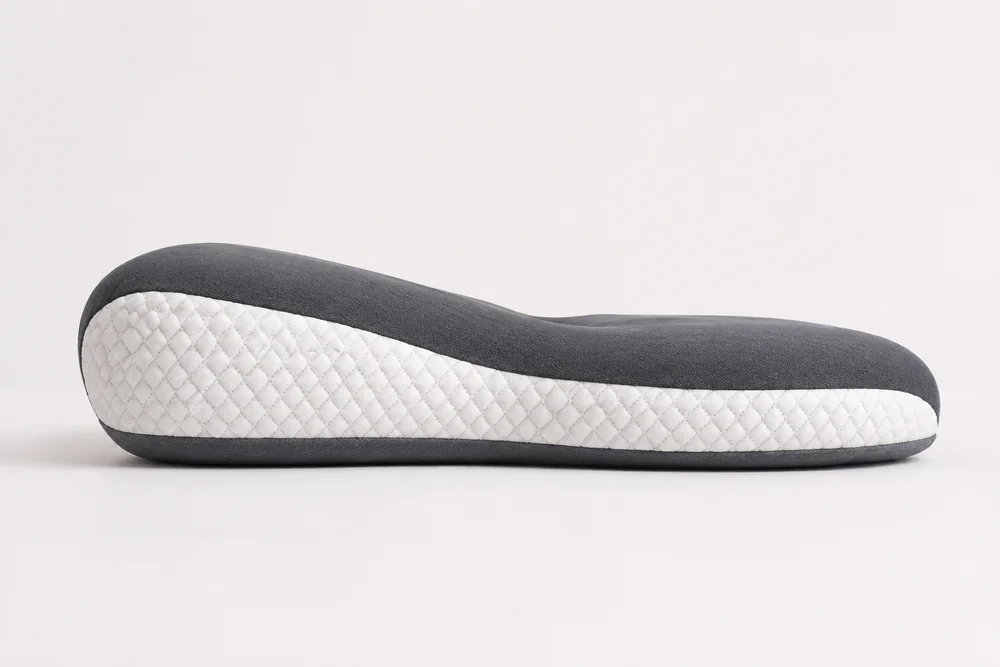
A single-height pillow can meet one of those. A pillow with two sides of different heights meets both, and switching costs a second: you turn the object over. That is the practical reason the shape exists, and how to choose your starting side is on the contour pillow page.
Whether a pillow can do anything about neck pain in the first place is a fair question, and it deserves a straight answer rather than a claim.
Common questions about neck support
How neck support pillows actually work
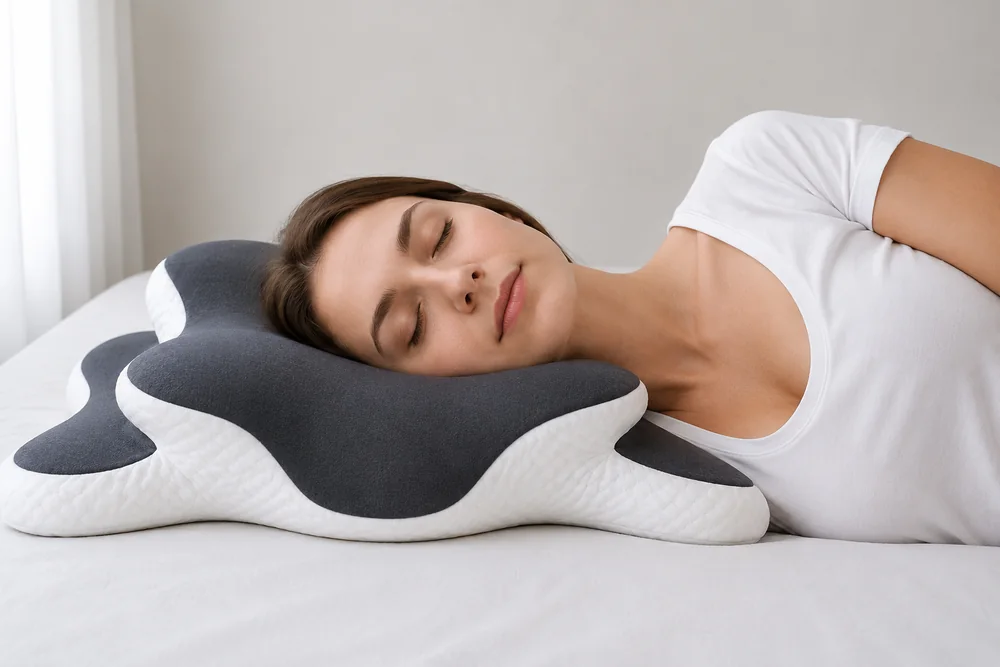
A pillow that genuinely supports keeps the arch behind your neck filled for the whole night, so the muscles along it stop working. Whether a given pillow does that is testable: lie down, have someone photograph you head-on, and check that nose, chin and the notch between your collarbones fall on a straight line. That takes thirty seconds and beats every claim on a box.
What is the difference between support and height?
Height is how far the pillow lifts you. Support is whether it is still lifting you that far seven hours later, with 11 lb of head on it. A tall soft pillow has plenty of the first and none of the second — it measures well in a shop and collapses under load. They are two different numbers and only one of them is printed.
What is the best neck support pillow for neck pain?
The one whose height matches your own shoulder-to-ear gap, made of foam dense enough to hold that height under load. Those two things are worth more than any feature list. Pain that persists for weeks, wakes you at night, or travels down the arm belongs with a doctor — a pillow governs the hours you are lying on it.
Are neck pillows good for you?
Holding the head, neck and top of the spine in line while you sleep is good for you, and that is what the shape is for. It is a matter of geometry rather than of medicine, which is why you can check it yourself rather than take anyone’s word for it.