
· Nora Fenwick
Neck pain after traveling
What actually happened to your neck
Your head weighs around 11 lb. Lying in bed, a mattress carries it. Sitting upright in a seat, nothing does — so the muscles along the back and sides of your neck hold it, continuously, for as long as you are in that position.
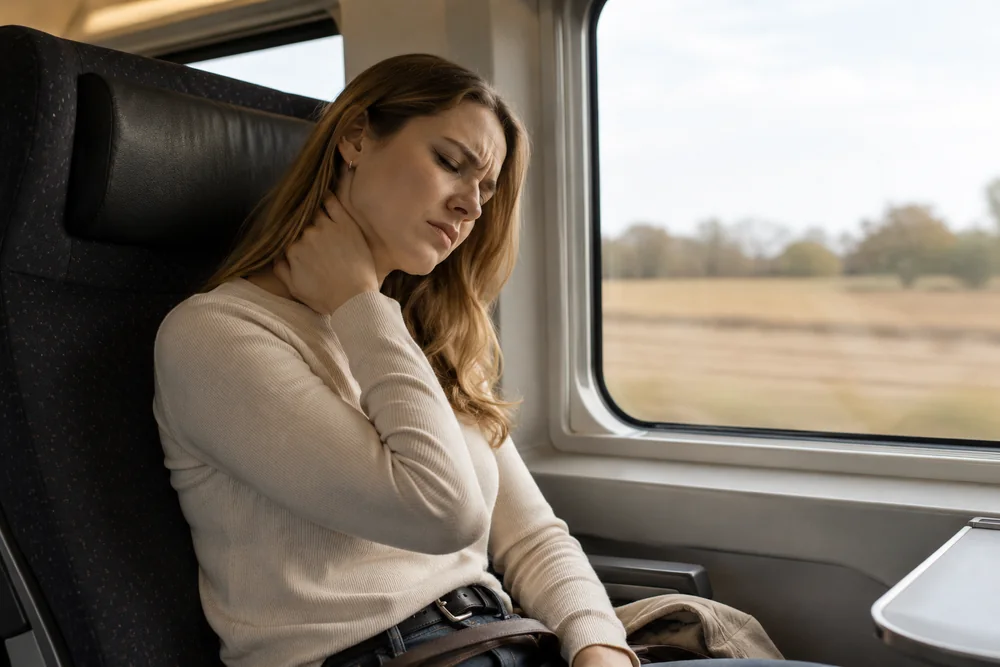
When you doze off, those muscles let go for a moment, the head starts to fall, and they snatch it back. That happens dozens of times over a long flight. By the time you land, the muscles have spent hours doing isometric work with no recovery, and they are inflamed and short. That is the stiffness.
Two things make it worse. Cold, because a cabin at 22 °C with an air vent on your shoulder keeps the tissue tight. And immobility, because muscles clear metabolic waste through movement, and there is none available in seat 34K.
The first 48 hours
- Move it, gently, early. Slow rotations, ear toward shoulder, chin toward chest — small range, no forcing, a few times an hour while you are awake. Rest makes a stiff neck stiffer.
- Heat, not ice. This is muscular tightness rather than an acute injury; warmth increases blood flow and helps the tissue lengthen. A hot shower with the water on the back of your neck for a few minutes is as good as anything sold for the purpose.
- Sleep it flat. The best thing you can give a neck that spent a night upright is a night properly supported. Which side of the pillow to use and how to check the alignment is on the firmness page.
- Drink. Cabin air is extremely dry and dehydrated muscle tissue is less pliable. It is the cheapest of these and the most often skipped.
Why the stiffness is usually on one side
Because the head does not fall straight forward — it falls toward whichever side was less supported. If you had a window to lean on, it fell away from the window; in a middle seat it falls to whichever side you drifted toward. One set of muscles was stretched all night while the other was shortened, and the shortened side is the one that hurts.
Practical consequence: the stretch that helps is toward the painful side, slowly, not away from it. And on the return leg, the fix is to remove the choice — a U-shaped pillow with the opening under the chin stops sideways travel in both directions. Which way round to wear it matters more than which one you buy.
Long drives are worse than flights, for a different reason
On a plane you can lean and you can recline. Driving, you can do neither: the head is held upright, the eyes are fixed forward, and the shoulders are up and forward on a wheel. The neck holds one position for hours with micro-corrections from every bump.
The countermeasures are boring and they work: stop every two hours, get out, roll the shoulders. Set the headrest so its middle is level with the middle of the back of your head rather than your neck. And as a passenger, a neck pillow is worth as much in a car as on a plane — as the driver, never, because it restricts how far you can turn to check a blind spot.
When it is worth seeing someone
Ordinary travel stiffness eases day by day and is largely gone within three. The following are not that, and they are worth a doctor rather than a stretch:
- Pain that travels down into the arm, or pins and needles, numbness or weakness in a hand.
- Pain that wakes you at night rather than being worst on waking.
- A neck that will not turn at all, or a headache that started with the neck pain and is getting worse.
- Anything that follows a jolt, a fall, or turbulence severe enough to throw you around.
- Swelling, redness, or pain in one calf after a long flight — that is not a neck problem and it needs attention quickly.
None of that is a reason to worry about a stiff neck after a flight, which is common and self-limiting. It is a list to check yourself against once, and then stop thinking about.
The return leg
Most of this is preventable, and the prevention is unglamorous: hold the head so the muscles do not have to. The seat decides how much you get interrupted, the pillow decides whether the head travels between interruptions. Choosing a seat and what else helps on board cover the rest.