
Orthopedic pillow: what the word covers
That gap between what the word suggests and what it guarantees is the useful thing to understand here. Below: what an orthopedic shape actually does, what the label does not tell you, and what to look at instead.
What the shape is built around
Strip the word away and an orthopedic pillow is defined by three measurable features, all of which come from the same observation: the head and the neck are not at the same height off a mattress.
A raised support along the front edge. Lie flat with no pillow and slide a hand behind your neck — there is a gap of an inch or two, and it is empty. An ordinary pillow makes it larger, because it lifts the skull without filling the arch. The raised edge fills it.
A lower region behind it. The skull is the heaviest thing on the bed and needs the least. Giving it somewhere to settle is what lets the neck support do its job rather than being crushed flat.
Enough density to still be there at six in the morning. This is the one that separates a shaped pillow from a shape-shaped pillow. A fiber filling holds a contour for a few weeks; high-density memory foam compresses locally and springs back, which means hour seven looks like hour one.
What the label does not tell you
Worth being blunt, because it saves money. “Orthopedic” is not a regulated term on a pillow in any of the markets we ship to. No test has to be passed, no body signs it off, and no one checks. It sits alongside “ergonomic” and “therapeutic” as a word that describes an intention rather than a verified property. British listings spell it orthopaedic; the spelling changes nothing about what has been proven.
The practical consequence is that the word cannot be used to compare two pillows. A flat rectangle with the word printed on the packaging and a properly contoured core with the same word cost the same to label. What separates them is visible in a side-on photograph, and invisible in the description.
So read the geometry: is there a raised edge, is there a lower region behind it, are the two long edges different heights, does the cover come off. Those four answers tell you more than the whole front of the box.
“What pillow do orthopedic doctors recommend?”
This is one of the most searched questions in the category and it deserves an answer that is not a sales line.
There is no such pillow. There is no brand that orthopedic doctors as a profession recommend, and any product page implying one is borrowing authority it has not been given. We are not going to do that here.
What clinicians do describe consistently is a principle: the neck should stay in line with the spine during sleep, and the height needed to achieve that depends on how you lie and how broad you are. That is advice about a measurement, not about a purchase. A pillow that meets it is doing what is being asked; a pillow that claims a professional endorsement is answering a different question than the one you asked.
If your neck pain persists for weeks, wakes you at night, or travels into the arm, that belongs with a doctor or a physical therapist. A diagnosis is not a shopping decision.
Side sleepers, and the shoulder
The most specific version of this search — the best orthopedic pillow for a side sleeper with shoulder pain — has an answer that is about height rather than about labels.
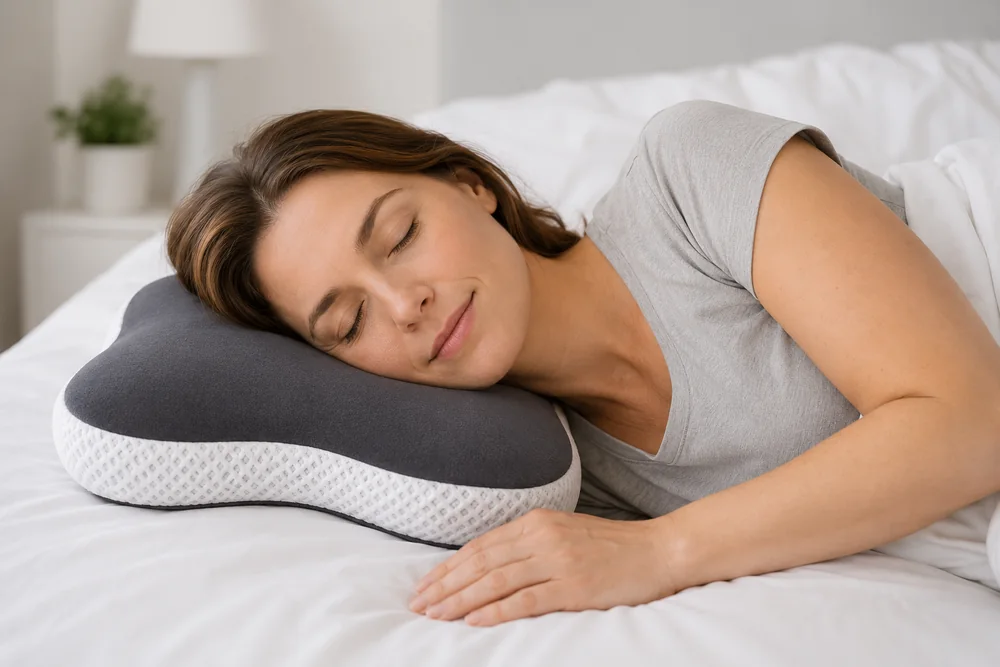
On your side, the distance from mattress to ear is the width of your shoulder, commonly 4 to 6 inches (10–15 cm). A pillow lower than that lets the head tip downward, which does two things at once: it bends the neck sideways, and it drives more of your body weight down through the shoulder that is already underneath you. People often read the second as a mattress problem when the height of the pillow is what changed.
The fix is more height on that side, not more firmness. Firmness only helps once the height is right; below it, a firm pillow is just a hard surface at the wrong altitude. If you also spend part of the night on your back, a pillow with two heights you can flip between avoids having to pick one and live with it.
What they actually do
Yes for the thing they are shaped to do, and it is a narrower thing than the marketing suggests — which is precisely why it is worth stating.
An orthopedic shape keeps your neck in line for the seven hours you are not thinking about it. If your neck was being held at an angle every night, that stops. Many people notice it within two weeks, and the ones who notice most are the ones coming off a pillow that had flattened.
Neck pain usually has a cause somewhere in the day: a mattress that has hollowed in the middle, a screen set two inches too low, an old whiplash. Those belong to the mattress, the desk and the doctor. What a pillow owns is the seven hours you spend on it, and it holds that stretch in line reliably.
Two things worth knowing before the first night: memory foam is stiff until it warms to skin temperature, which takes two to five minutes, and a neck used to another angle takes two to three weeks to settle. Both are covered on the memory foam page.
Common questions about orthopedic pillows
How orthopedic pillows really work
The good ones work for one thing: keeping your head, neck and the top of your spine in line all night instead of bent. That is geometry and you can verify it on yourself with the line test. What none of them do is treat a condition — the word on the box is a description of shape, not a clinical result.
What pillow do orthopedic doctors recommend?
There is no single pillow that orthopedic doctors recommend, and any brand claiming one is stretching. What clinicians consistently describe is a principle rather than a product: keep the neck in line with the spine, and choose the height from your sleeping position and shoulder width. A shape that does that is doing what they ask of it.
Is “orthopedic” a regulated word on a pillow?
On a pillow, no — it is a marketing description in every market we ship to, and nothing has to be proven before it is printed. That is exactly why it is worth ignoring the word and reading the geometry instead: the height of the neck bolster, the depth of the hollow, the density of the foam.
What is the best orthopedic pillow for side sleepers with shoulder pain?
For side sleepers the height is what matters, not the label: you are filling the gap between mattress and ear, which is the width of your shoulder — often 4 to 6 inches. A pillow too low tips the head down and loads the shoulder further. Shoulder pain that persists is worth raising with a doctor; a pillow can stop the night adding to it, not resolve it.