
· Nora Fenwick
How to use a travel neck pillow
That one instruction accounts for most of the disappointment with these pillows. Below: why the orientation matters, how to stop your head pitching forward, and what changes in a car, a train and a window seat.
The opening goes at the front
Look at a U-shaped pillow from above and you have a thick horseshoe with a gap. Almost everyone puts the gap at the back, where the neck is, because that is where the neck seems to need room.
It is the wrong way round, and here is why. Sitting upright, your head does not fall backwards — the seat is behind you. It falls forwards and sideways, because nothing is holding it there. Put the gap at the front and you have removed material from precisely the place the head is trying to go.
With the opening under your chin, the two ends act as a stop on either side of your jaw, and the thick section behind cushions your head against the headrest. The head cannot travel far in any direction, which is the whole point.
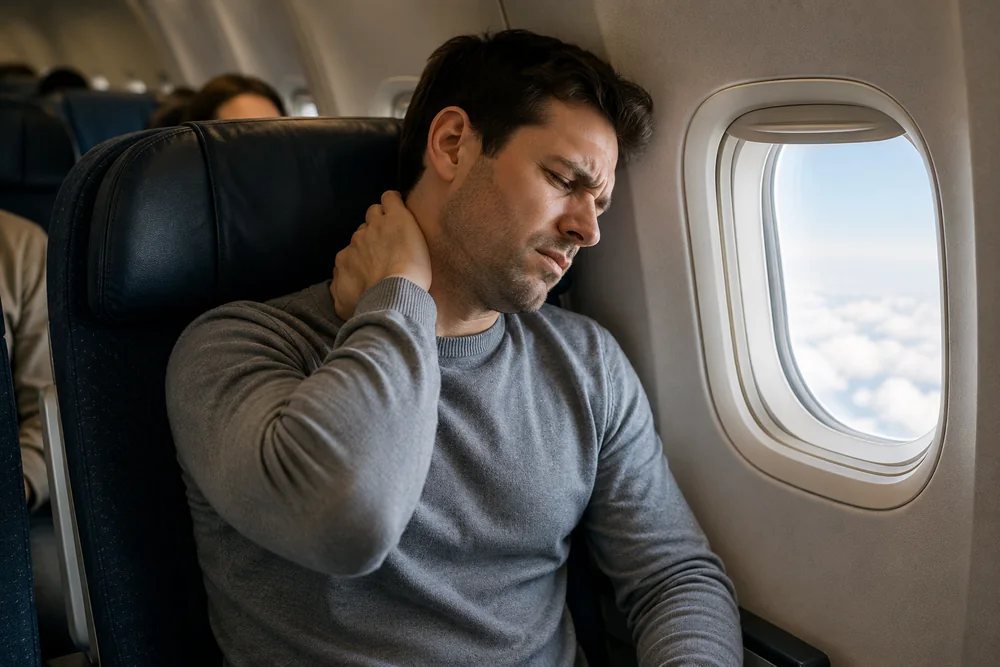
Getting the fit right
A neck pillow works by contact. Gaps are where the head accelerates before it hits something.
- The ends should nearly touch. If there is a hand’s width between them under your chin, your head still has somewhere to fall. Push it round until the gap closes to a couple of inches.
- Sit back first, then fit the pillow. Putting it on and then shuffling backwards drags the pillow up your neck and leaves it sitting behind your head instead of under it.
- Shoulders down. The base of the pillow rests on your shoulders. Hunched up, it perches higher and tips your chin forward.
- Recline what you can. Even two inches of recline shifts the balance point of your head backwards, which is where the pillow is.
Stopping the forward nod
The classic failure is the slow forward nod: you fall asleep, the chin drifts down onto the chest, and you wake up with a strained neck. The pillow is not doing nothing — it is simply not built to catch weight coming from that direction unless you help it.
Two adjustments deal with almost all of it. Rotate the pillow a quarter-turn so the thickest part sits where your head actually wants to go — for most people that is slightly to one side rather than dead center. And fill the gap between your shoulder and the window or the seat: leaning is stable, hovering is not.
If your head consistently falls to one side, you are a side-leaner. Wear the thick section on that side rather than centerd behind you, and let the seat take the rest.
What changes by mode of transport
| Where | What to do differently |
|---|---|
| Plane, window seat | The best of the three. Turn slightly toward the window and let the thick part bridge the gap between your head and the fuselage. |
| Plane, middle or aisle | Nothing to lean on, so the fit under the chin matters more. Close the gap fully and recline as much as you are allowed. |
| Train | Headrests are usually higher. Push the pillow down onto your shoulders rather than letting it ride up behind your head. |
| Car, as a passenger | Wear it with the opening at the front as usual. In a car the lateral movement is the problem, and the two ends are what handle it. |
| Car, as the driver | Not at all. A neck pillow restricts how far you can turn your head to check a blind spot. |
Packing it without ruining it
A memory foam travel pillow compresses down to a fraction of its size and springs back — that is the advantage over a bead-filled one, which stays the size it is. Most come with a bag or a strap for exactly this.
Two things worth knowing. Do not leave it compressed for weeks. Foam left squashed in a drawer between trips takes progressively longer to recover its full height, and eventually stops. Take it out of the bag when you get home. And give it a few minutes to expand before you use it: straight out of the bag it is at maybe two-thirds of its height, and it reaches full size after five to ten minutes at body temperature.
Cleaning it after a trip
Same rule as any memory foam pillow: the foam never goes in a machine, the cover does. Unzip it, wash at 86 °F / 30 °C, air dry. Between washes, twenty minutes out of its bag near an open window deals with most of what a long-haul flight leaves behind. The full method, including what to do about a stain on the foam itself, is in the washing guide.
When the pillow is not the problem
If you have the orientation right, the gap closed, and you still cannot sleep sitting up, the constraint is usually the seat rather than the pillow. An upright back with no recline puts your center of mass in front of your base, and no amount of neck support fixes a torso that wants to fold. Sleeping on a plane covers what does help there, and choosing a seat deals with the decision you make before boarding.
The pillow’s job is narrower and it does it well: it stops your head traveling while your neck muscles are off duty. That is what the shape is for, and it is why the orientation is worth getting right.