
Memory foam knee pillow
A knee pillow does one thing: it stops your upper leg falling past the lower one, so your pelvis stays square to your shoulders. The difficulty is not the idea — it is finding one that is still between your knees at 6am.
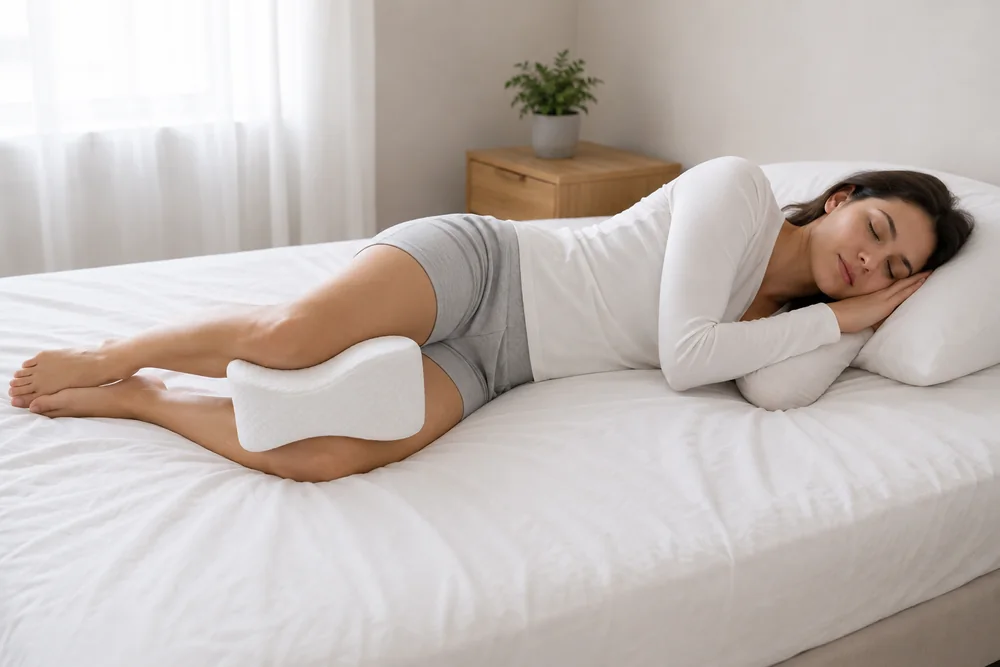
Why a folded towel stops working around 2am
The three-night towel test is still the right way to start, and it costs nothing. It answers one question well: are your hips the reason you wake stiff? What it cannot answer is whether a dedicated pillow is worth buying, because the towel fails at a job the pillow is shaped to do.
Two things go wrong with folded fabric. It loses height under load — a towel that measured the width of your thigh at bedtime is half that by the small hours, and the upper knee starts landing in front of the lower one again. And it migrates, because nothing holds it: every time you shift, it travels a little further toward your ankles, where it has no leverage at all.
You do not wake up when either happens. You wake up in the morning with the same stiff first hour you were trying to get rid of, and you write the idea off.
The shape: an hourglass holds, a block slides
Most of what separates knee pillows is the outline, not the material. A plain rectangular block has nothing to grip: the knees rest on flat faces, and flat faces let a leg slide off sideways the moment you move.
A contoured pillow is waisted in the middle — narrower where the knees sit, flaring above and below. The knees settle into the waist and the flares stop them travelling forward or back. It is a small difference to look at and it is most of the difference in use, because the failure mode of a knee pillow is never that it was too soft. It is that it was somewhere else by morning.
Density: a knee pillow carries a load a head pillow never does
A head pillow supports around five kilos, pressing straight down. A knee pillow takes the weight of a whole leg, pushing sideways — and it takes it for seven or eight hours without a break.
That is why soft foam is the wrong answer here even though it is the right answer under a head. Low-density foam compresses to its limit under a leg within the first hour and then behaves exactly like the folded towel: present, but no longer holding anything apart. Higher density feels firmer at bedtime and is still doing its job at 5am, which is the only moment that counts.
The trade-off is honest: a dense core is warmer and firmer under the knee than a soft one. Anyone slight, or anyone who finds firm foam uncomfortable against the bone, is better served by a pillow with a little more give and a lot more shape.
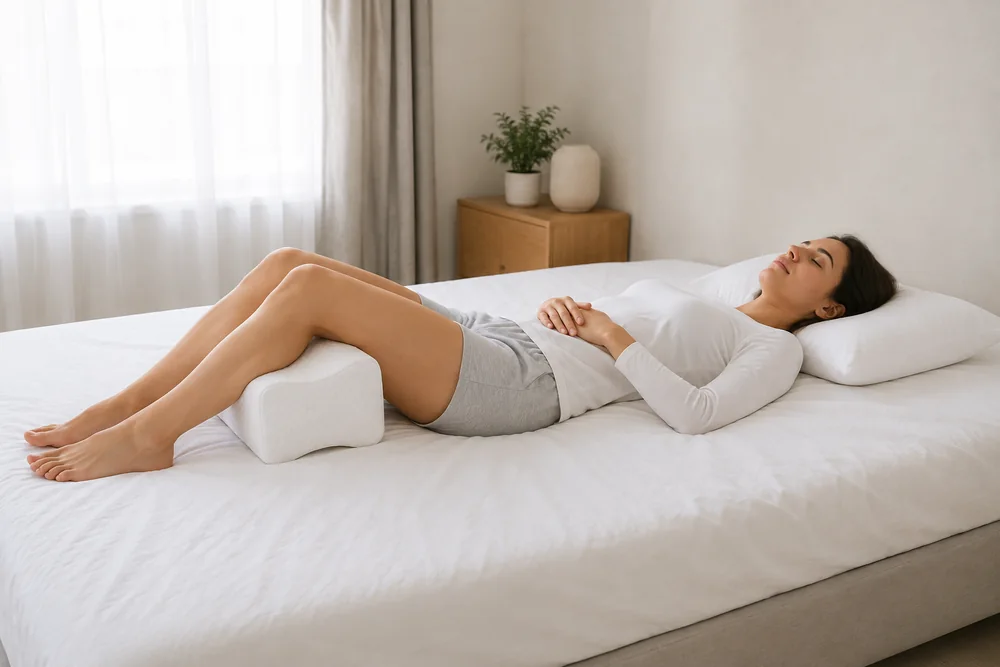
On your back: the same pillow, a different place
Side sleeping is not the only use, and the second one is the reason a lot of people keep the pillow after their back stops hurting.
Lying on your back with your legs straight, the pelvis tilts forward and the lower back arches away from the mattress — you can usually slide a hand into the gap. Something under the knees bends the hips a few degrees, rotates the pelvis back, and lets that curve settle onto the bed.
The placement is different and so is the feel: under the knees it wants to be lower and broader than it does between them. Most people find one pillow covers both if they are willing to move it, and that is worth knowing before buying two. Setting up for back sleeping covers the rest of that position.
The strap, and whether you want one
Several knee pillows come with a strap that fastens around the thigh. It solves the migration problem outright: strapped on, the pillow cannot go anywhere, including when you turn over.
It also introduces one. A strap tight enough to hold is a strap you can feel, and turning from one side to the other with a pillow attached to one leg is a different movement from turning freely. People who barely move at night rarely need it. People who turn four or five times usually either love it or take it off in the first week — there is not much middle ground.
This one holds its place by shape rather than by strap: the waist grips the knees, so there is nothing to fasten around a thigh and nothing to unclip when you turn over. It is the shape that does the holding, which is why it survives a night of turning without being attached to you.
Heat, and the cover that comes off
Between the thighs is the warmest place in the bed, and foam is not a cool material. Anyone who sleeps hot will notice a knee pillow before they notice a head pillow.
Almost all of that is decided by the cover rather than the core. A knit that moves air lets the heat leave; a smooth laminated fabric holds it against the skin. This cover unzips along its full length, washes at 30 degrees and dries flat — which matters more here than on a head pillow, because of where the pillow spends the night.
The foam itself never goes in a machine. It absorbs water, takes days to dry, and comes apart from the inside if you try.
After a knee operation, ask the person who operated
The most searched question about knee pillows is why people are told not to put one under the knee after knee surgery. The short version is that a knee held bent for hours can become harder to straighten again, and getting full extension back is usually one of the stated goals of recovery.
That is the general reasoning, and it is as far as a pillow shop should go. The instruction differs by procedure, by surgeon and by how far into recovery you are — and the person who handled your case is the one whose answer applies to you. If you are in that situation, ask them before ordering anything, including this.
The other end of the same spine
The commonest disappointment with knee pillows has nothing to do with the pillow: people fix one end of the spine and wonder why they still wake stiff.
A side sleeper can be bent at the top — head tipping toward the mattress because the head pillow is too low — or twisted at the bottom, from the leg falling forward. Each is fixed at its own end, and fixing one does nothing for the other. The knee pillow handles the bottom. The top is decided by a single measurement, the gap between the mattress and your ear: thirty seconds to find yours. Our side sleeper pillow covers that end, and the side-sleeping guide puts the two together.
Frequently asked questions
How do you use a knee pillow?
Lying on your side, it goes between the knees — not between the ankles. The knee is where the leverage is: hold the knees apart and the hips stay stacked all the way up. Pull it in until it touches both knees, then let your top leg rest on it rather than gripping it.
Are knee pillows any good, or is a folded towel enough?
A folded towel proves the principle for three nights, which is the cheapest way to find out whether your hips are the problem at all. What it does not do is stay put: it compresses to nothing and works its way out. If the towel helps and then stops helping by morning, that is the migration, not the idea failing.
Between the knees or under them?
Between, if you sleep on your side — the job is to stop the upper leg dropping past the lower one. Under, if you sleep on your back — there the job is to unload the arch in the lower back. Same pillow, two placements, and the choice is decided by the position you actually fall asleep in.
Why are you told not to put a pillow under the knee after knee surgery?
Because a knee held bent for hours can become harder to straighten again, and regaining full extension is usually a stated goal after an operation. This is a question for the surgeon or physiotherapist who handled your case, not for a pillow shop — the instruction differs by procedure and by stage of recovery, and theirs is the one to follow.
Does it work for hip pain as well as the lower back?
The mechanism is the same one: the pillow stops the upper leg falling forward, so the pelvis stops rotating. People often notice the hip and the knees before the back, because bone resting on bone through a night is its own source of waking.
Can you wash it?
The cover unzips and washes at 30 degrees, dried flat. The foam itself never goes in a machine — it holds water, takes days to dry and breaks down from the inside.
Will it get hot between the legs?
It is a warm place to put foam, and a dense core does hold heat. That is what the cover is for: a knit that moves air rather than a laminated fabric that traps it. If you sleep hot, this is the part to look at before the foam.
How long is delivery?
Six to ten working days, shipping included, to the United States, Canada, the United Kingdom and Australia. A tracking number is sent the moment the parcel leaves.
What buyers say
This pillow is new to the range and has no reviews of its own yet. The comments and photographs published by buyers of our other pillows are on our reviews page.