
· Nora Fenwick
The best pillow for side sleepers
Below: the four criteria in the order they actually matter, a table you can hold a product photograph against, and what clinicians actually recommend.
1. Height — decided by your shoulder, not by taste
Side sleeping puts the largest gap of any position between your head and the bed, because your shoulder is holding your whole upper body up. Fill that gap exactly and your neck stays in line. Fill it short and your head tips down toward the mattress, bending the neck sideways for seven hours in the direction it has the least range in.
Measure rather than estimate: stand one shoulder against a wall and measure to the middle of your ear, or lie down and have someone photograph you head-on. Both methods here. Broad shoulders need noticeably more, and this is the single biggest difference between two people buying the same pillow.
2. Firmness — but only after height
Height is how far the pillow lifts you. Firmness is whether it is still lifting you that far under 11 lb of head, seven hours later.
Side sleepers get caught by this more than anyone, because they need more height and therefore have more to lose when it collapses. A lofty soft pillow measures well in a shop and gives you the right height for about a minute.
The order matters and it is not interchangeable. A firm pillow that is two inches too low is a hard surface at the wrong altitude, and buying something firmer is the standard wrong response to waking up stiff.
3. Room for the arm
Every side sleeper does something with the lower arm, and on a plain rectangle all the options interfere with the pillow. Under it, the arm lifts the whole thing and takes your head up with it. Under your head, your shoulder carries your skull as well as your torso.
A shaped outline with a notch between the raised side region and the middle gives the arm somewhere to go without moving the surface your head rests on. It is the least advertised feature of these pillows and one of the most useful — what the wings are for.
4. Two heights, if you move
Most people who describe themselves as side sleepers spend part of the night on their back, where the required height is roughly half. One flat object cannot be both, and stacking a second pillow at three in the morning is not a thing anyone actually does.
Two sides at different heights settles it by turning the pillow over. How that is meant to be used.
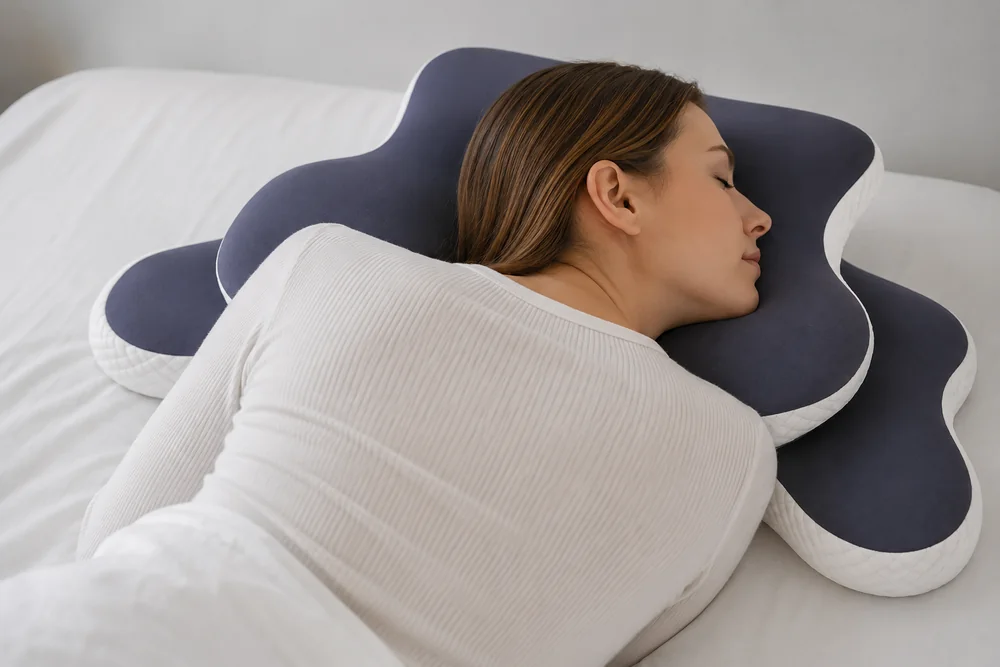
Holding a product photograph against the criteria
| What to look for | Good sign | Warning sign |
|---|---|---|
| Side-on silhouette | Two distinct heights, a visible raised edge | Flat profile, however it is described |
| Stated height | A number you can compare to your own | “Adjustable” with nothing given |
| Foam density | High-density memory foam, return in 3–5 seconds | “Soft memory foam”, shredded filling for a side sleeper |
| Outline from above | A notch or wing for the arm | Plain rectangle |
| Cover | Unzips, machine washable | Sewn on — the pillow then has a shelf life |
“What pillow do chiropractors recommend for side sleepers?”
People search this a great deal, so it deserves a straight answer: there is no pillow that the profession recommends, and any brand implying otherwise is borrowing authority it has not been given. We are not going to do that here.
What practitioners describe consistently is a principle rather than a product — keep the neck in line with the spine, and take the height from the sleeping position and the build of the person. That is advice about a measurement. A pillow that meets it is doing what is asked of it, whoever made it.
If your neck pain persists for weeks, wakes you at night, or travels down into the arm, that is a matter for a doctor or a physical therapist. A diagnosis is not a shopping decision.
Two things that help and are not pillows
A pillow between the knees. Stops the upper leg sliding forward and rotating your pelvis, which is behind a lot of morning back stiffness that gets blamed on the mattress. Costs nothing to try tonight with a folded blanket.
A mattress that lets the shoulder in. On a very firm mattress the shoulder cannot sink at all and takes the pressure directly. If your pillow height is right and the shoulder still aches, that is where to look next.
The full position guide, including which side to face and what to do about the arm, is in sleeping on your side.