
· Nora Fenwick
Sleeping on your back
The gap is small, and it is not where you think
Lie flat on a bare mattress and slide a hand behind your neck. There is a space of an inch or two, and it is empty. Now feel behind your head: your skull is already resting on the bed and needs nothing at all.
An ordinary pillow gets this exactly backwards. It puts its full thickness under the part that needs the least, lifts the skull, and in doing so opens the arch behind the neck further. The gap you were trying to fill gets bigger.
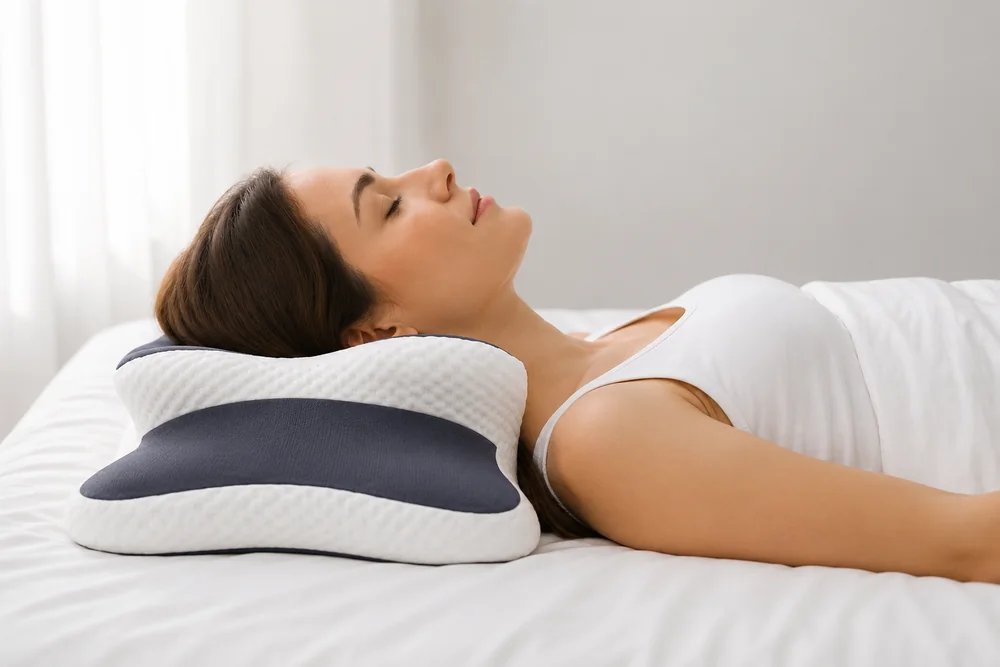
What a back sleeper actually wants is material under the curve of the neck and space for the head to settle behind it. That is what a raised front edge on a contour pillow does, and it is why these pillows look strange the first time you see one.
The chin test
Faster than any measurement, and you can do it right now. Lie on your back, relax, and notice where your chin is.
- Chin pointing at the ceiling: the head has been pushed back. Usually too little support under the neck rather than too much pillow.
- Chin dropping toward the chest: too much pillow. This is by far the most common, and it holds the neck in flexion for seven hours.
- Chin level, roughly as it is when you stand: right.
The second one is the classic. It also explains a symptom people rarely connect to bedding: waking with a dry mouth or a sore throat, because a chin driven onto the chest narrows the airway and pushes you to breathe through your mouth.
The pillow under your knees
The single most useful addition for back sleepers, and almost nobody does it.
Lying flat with your legs straight, your pelvis tilts forward and your lower back arches away from the mattress — you can usually slide a hand under it. Holding that arch for seven hours is work, and it is a common source of morning back stiffness.
A pillow under the knees bends the hips slightly, which rotates the pelvis back and lets the lumbar curve settle onto the bed. The gap closes, the muscles stand down. A folded duvet works; a wedge or a bolster works better because it stays put.
Shoulders off the pillow
Worth saying because it undoes everything else. The bottom edge of the pillow meets the tops of your shoulders — it does not sit under them.
Shoulders up on the pillow lifts your whole upper back, and the head follows, which recreates the chin-to-chest angle you just fixed. If you find yourself gradually sliding up the pillow through the night, that is usually the pillow being too big rather than you moving.
Snoring, and what a pillow has to do with it
Snoring is often worse flat on the back, because the airway is more easily obstructed in that position. That is a real pattern, and it is where a pillow comes into it: raising the head slightly, or making side sleeping comfortable enough that you stay there, changes it for some people.
That is a consequence of position and comfort, not a treatment, and it will not be true for everyone. Snoring that is loud, that breaks off into pauses, or that leaves you exhausted despite a full night is worth raising with a doctor — sleep apnea is diagnosed, not cushioned.
What back sleeping is good at
It spreads your weight over the largest area of any position, which means no single joint is carrying you — unlike side sleeping, where one shoulder and one hip take most of it. It also keeps your head, neck and spine in one plane naturally, so there is less to get wrong once the height is right.
If you sleep on your back and wake comfortable, there is nothing here to fix. The reason this page exists is that the most common setup — a thick soft pillow under the head — quietly works against all of that.
If you move around
The back height is roughly half the side height, so a pillow set up correctly for your back leaves your head tipping down on the nights you turn over. Two heights on one pillow handles both, and switching means turning the object over rather than making a decision at four in the morning — how that is meant to be used.
The side-sleeping detail, including what to do with the arm and the knees, is in that guide. And the measurement that decides all of it is in what pillow height do I need.