
· Nora Fenwick
A pillow between your knees
The twist you cannot feel while it is happening
Stand up and put one foot a long stride in front of the other, then look down at your hips: one is forward of the other, and your lower back has rotated to let that happen. Now imagine holding it for seven hours.
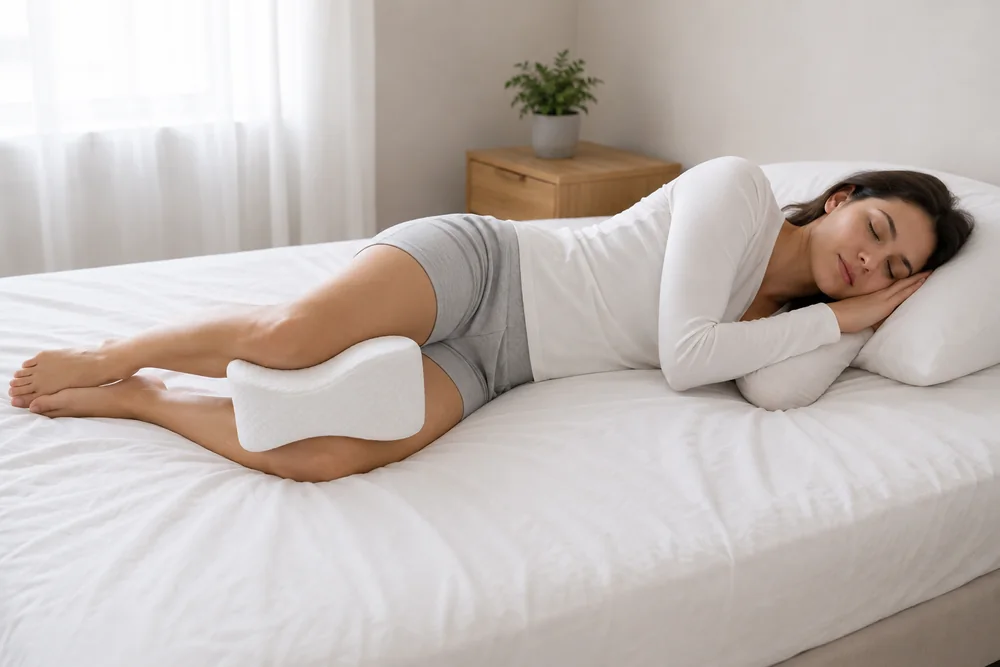
That is close to what happens in bed. Your upper leg is heavier than the air it would otherwise rest in, so it falls forward and down onto the mattress. The knee lands in front of the lower knee, the hip follows, and your pelvis ends up facing the bed while your ribcage is still facing sideways. The rotation is taken up by the lumbar spine.
You do not feel it happening because you are asleep. You feel it in the morning, as a lower back that is stiff for the first hour and fine afterwards — which is exactly the pattern people attribute to the mattress.
What the pillow corrects
Placed between the knees, it stops the upper leg from dropping past the lower one. The hips stay stacked, the pelvis stays square to the shoulders, and there is no rotation left for the lower back to absorb.
Two secondary things it does, both of which people notice before the back:
- The knees stop pressing on each other. Bone on bone through a night is its own source of waking, particularly for anyone slight.
- The upper leg stops dragging the torso forward. That forward roll is part of what loads the shoulder underneath you, so this helps a sore shoulder as well as a sore back.
How to try it tonight for nothing
You do not need to buy anything to find out whether it helps you.
- Fold a blanket or a bath towel until it is roughly the thickness of your own thigh — that is the target: the gap you are filling is the width of one leg.
- Put it between your knees, not between your ankles. The knee is where the leverage is.
- Sleep on it for three nights before deciding, and notice the first hour after getting up rather than how it feels at bedtime.
If it helps, a dedicated knee pillow is worth having for one reason only: a folded towel migrates during the night and a shaped one does not. If it makes no difference in three nights, your pelvis was probably already staying square and you can stop thinking about it.
Getting the thickness right
| What you notice | What it means |
|---|---|
| Upper knee still lands in front of the lower one | Too thin — the leg is falling past it |
| Legs pushed uncomfortably apart, hip feels open | Too thick |
| Knees level, hips stacked, no strain at the hip | Right |
| It has moved by morning | Thickness may be fine; the shape is not holding position |
For back sleepers: under the knees, not between
The same principle applies lying on your back, in a different place. With your legs straight, the pelvis tilts forward and your lower back arches away from the mattress — you can usually slide a hand under it. Holding that arch for seven hours is work.
A pillow under the knees bends the hips slightly, rotates the pelvis back, and lets the lumbar curve settle onto the bed. The gap closes and the muscles stand down. More on setting up for that position in sleeping on your back.
The two ends of the same problem
Worth seeing them together, because people fix one and wonder why they still wake stiff.
Your spine runs from your skull to your pelvis. A side sleeper can have it bent at the top — head tipping toward the mattress because the pillow is too low — or twisted at the bottom, from the leg falling forward, or both. Each is fixed at its own end, and fixing one does nothing for the other.
The knee pillow handles the bottom. The head pillow handles the top, and it is decided by a single measurement: the gap between the mattress and your ear, which is the width of your shoulder. Thirty seconds to find yours. The whole side-sleeping setup is in that guide.