
· Nora Fenwick
Why pillows turn yellow
It is almost universal, it starts earlier than people expect, and how much it matters depends entirely on which of the four is doing it.
1. Sweat
The big one. A sleeping adult loses a meaningful amount of moisture through the night, and a good deal of it goes downward into the pillow. Sweat is mostly water, but what it leaves behind when the water evaporates — salts and the rest — stays in the fibers or the foam and darkens over time.
This is why the yellowing is never even. It is heaviest where your head rests and around the edges of that patch, which is exactly the map of where you sweat most.
2. Skin oils and whatever is on your face
Sebum transfers all night, along with anything you put on before bed: moisturizer, hair product, sunscreen left over from the day. Oils are worse than sweat in one respect — they do not evaporate. They sit in the fabric and oxidize, which is a slow darkening you cannot rinse out once it is established.
Going to bed with wet hair is the version of this that surprises people. It adds hours of damp on top of the oils, in the same spot, every night.
3. Damp that never fully dried
The one that does actual harm. If moisture is put into a pillow faster than it leaves, the core stays slightly damp permanently — and a damp core discolors from the inside and eventually smells.
Two habits cause most of it: making the bed immediately on getting up, which seals the night's moisture in, and putting a cover back on before it is completely dry after washing. A pillow that smells musty even with a freshly washed cover has this problem, and no surface cleaning reaches it.
4. Sunlight
Ultraviolet light yellows polyurethane foam directly — it is a change in the material, not a stain on it. It also makes the foam brittle, so this is the only cause on the list that shortens the pillow's life as well as its looks.
Which is why the standard advice to "air it in the sun" is wrong for memory foam. Air it, yes — near an open window, in the shade. A pillow left on a sunny windowsill ages faster than one that is slept on every night.
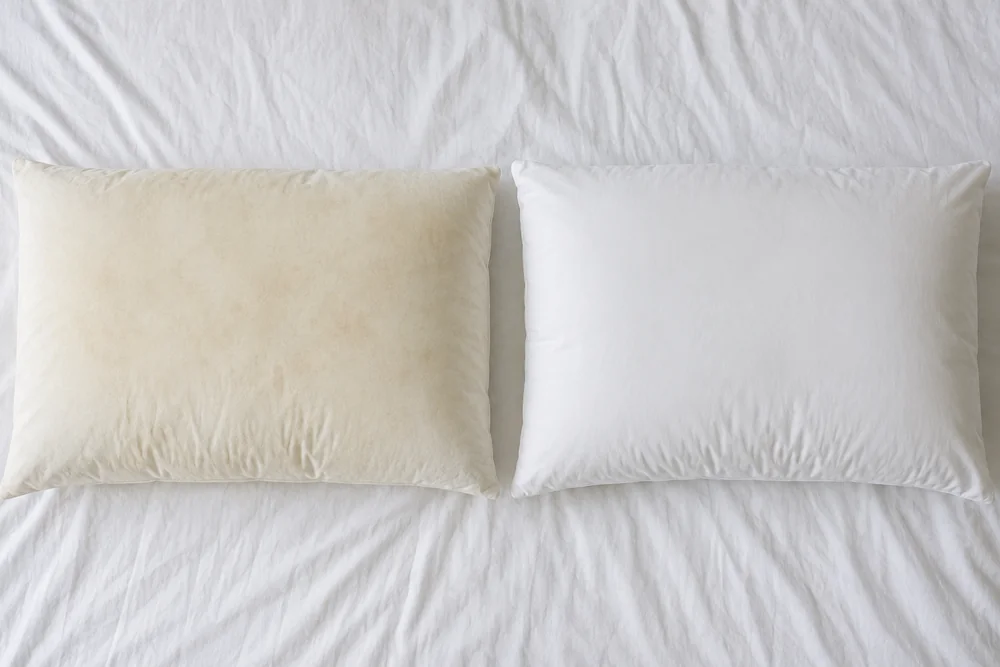
What you can undo, and what you cannot
| What it is | Can it be reversed? |
|---|---|
| Marks on a washable cover | Usually. A hot wash within the fabric's tolerance lifts most of it. |
| Surface marks on foam | Sometimes, with damp spot-cleaning. Never by soaking. |
| Yellowing through a fiber filling | No. The staining is in the fibers. |
| Yellowing through a foam core | No. And if it is UV yellowing, the foam is degraded as well as discolored. |
The practical line: anything on the cover is a laundry problem, anything in the core is a replacement decision. And a core that is yellow all the way through has usually stopped performing too — the fist test settles that in three seconds. The four tests.
Slowing it down
Two layers, both washed. The zip cover takes the first pass, an ordinary pillowcase over it takes the wear. Wash the case with the bedding, the cover every two to four weeks. This is worth more than everything else combined, because it intercepts the sweat and oils before they arrive.
Let the bed breathe. Pull the covers back for twenty minutes before making it. It costs nothing and it lets the night's moisture leave rather than sealing it under a duvet.
Dry hair, and a gap after skincare. Both put damp and oil straight into the same spot.
Air the pillow itself. Cover off, near an open window, in the shade — once a week for twenty minutes, once a month for a few hours.
What not to reach for
- Bleach on foam. It attacks the material. On a cover, check the label first — it also weakens fibers over time.
- A washing machine, for the foam. The single fastest way to turn a working pillow into a dead one. What to do instead.
- Fabric softener. It coats a knitted cover and closes the airflow the pillow was designed around, which makes you sweat more into it.
- A hairdryer or a radiator to speed up drying. Heat melts the cell walls and leaves a hard patch that never softens again.
Is a yellow pillow a problem?
Cosmetically, that is your call. Functionally, the color tells you nothing on its own — what matters is whether the pillow still holds its height. A slightly discolored high-density core that comes back in four seconds is doing its job. A pristine-looking one with a permanent hollow is not.
The exception is damp. A core that stays cool and heavy in the middle, or smells musty through a clean cover, is holding water — and that is worth acting on rather than looking at.