
· Nora Fenwick
When to replace your pillow
The reason this matters is that a pillow fails slowly. It loses a quarter of an inch a month, you adapt without noticing, and one morning your neck aches and nothing obvious has changed.
The four tests
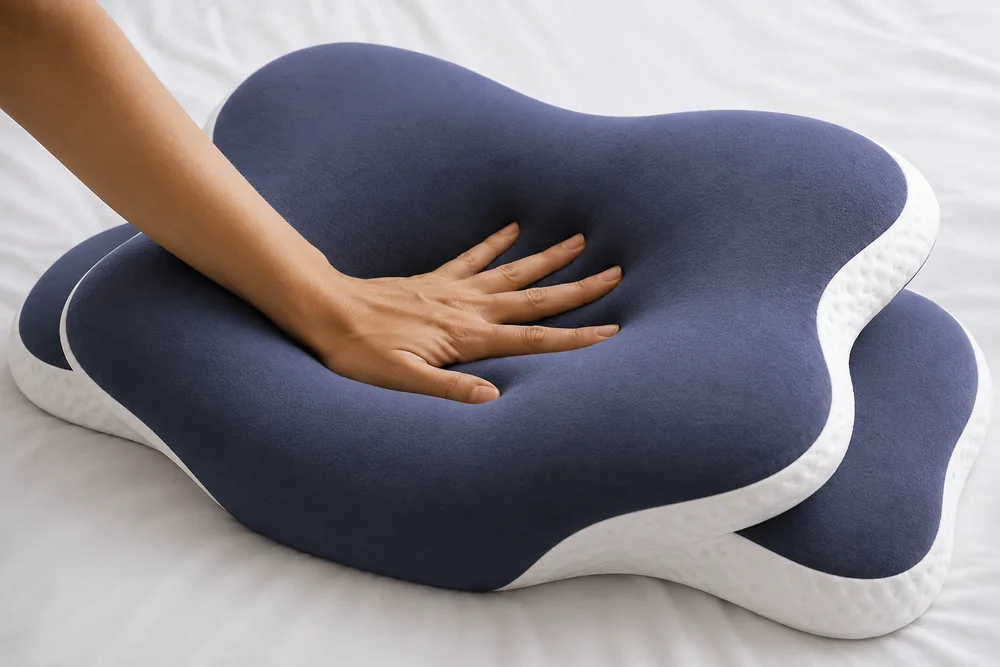
- The fist test. Press into the middle, take your hand away, count. Three to five seconds is proper viscoelastic foam. Instant means it is not memory foam at all. Still dented after ten seconds means the density has gone.
- The morning test. Look at the pillow when you get up. If the shape of your head is still in it, the foam has stopped returning — and it has been failing for months rather than days.
- The fold test (fiber and down only). Fold it in half and let go. A healthy fiber pillow springs open. One that stays folded has packed down and will not recover.
- The height test. Lie on your side and have someone photograph you head-on. If your head is tipping toward the mattress on a pillow that used to be right, it is the pillow that changed. The full method.
The two materials fail in opposite ways
Fiber and down lose their loft. The filling packs down under repeated compression and does not spring back. It goes flat, and it goes flat fast — a synthetic fiber pillow is usually noticeably lower within six to twelve months. The failure is even: the whole pillow gets thinner.
Memory foam loses its rebound. The cell walls that give the material its slow give break down gradually. The pillow keeps its outline, so it still looks fine, but it stops returning to shape — and the failure is local, concentrated exactly where your head goes. You end up with a dish that has become permanent.
That difference explains why people misjudge memory foam. A flat fiber pillow is obviously finished. A memory foam pillow with a permanent hollow looks like a pillow with a hollow in it, which is what you bought.
What the numbers are worth
| Filling | Typical working life | What ends it |
|---|---|---|
| Synthetic fiber | 6–18 months | Loft packs down |
| Down and feather | 1–3 years | Clumping, loss of loft |
| Low-density memory foam | 1–2 years | Rebound goes, hollow becomes permanent |
| High-density memory foam | Several years | Same, much later |
Treat those as orders of magnitude, not promises. The variables that move them are your weight, how warm you sleep, how much you sweat, and whether the pillow has a cover that is actually washed. A number on a box cannot know any of those, which is why the tests are worth more than the table.
Signs that are not about age
- You are folding it in half to get enough height. A very reliable tell, and one people do for months without registering it. The pillow is now half its footprint and twice its intended height, which is the wrong shape in both dimensions.
- You wake stiff and are fine within an hour. That pattern points at position, and a collapsing pillow is one of the more common causes. Reading the stiffness.
- It smells even after the cover is washed. That is moisture in the core rather than dirt on the surface, and airing has stopped fixing it.
- Visible yellowing right through. Surface marks are cosmetic; discoloration that has soaked into the middle means years of absorbed moisture. Why that happens.
How to make one last
Three habits, in order of how much they buy you:
Use a cover and wash it. The cover takes the sweat and skin oils that would otherwise go into the filling. Washing it every two to four weeks is the single biggest factor in how long the pillow underneath survives. Add an ordinary pillowcase over the top and you double the interval.
Air it. A sleeping adult loses a surprising amount of moisture through the night and foam does not breathe freely. Twenty minutes off the bed with the cover off, near an open window, once a week. Away from direct sun, which yellows foam and makes it brittle.
Never machine wash the foam. Water destroys the cell structure and the spin cycle tears it. This is the one action that turns a pillow with years left into a pillow to throw out, in a single cycle. What to do instead.
What to do with the old one
Foam is not recyclable through household collection, and most textile banks will not take a whole pillow. Two things it is genuinely good for: cut down as padding for a pet bed, or as stuffing for cushions and draft excluders. Animal shelters sometimes accept clean bedding — worth a phone call before it goes in the bin.
What is not worth doing is keeping it as a spare. A pillow that failed for you will fail for a guest, and the spare-room pillow that everyone complains about is almost always the one that was retired rather than replaced.