
· Nora Fenwick
Sleeping without a pillow
The question is asked as though a pillow were a habit. It is closer to a spacer: whether you need one, and how thick, is set by the gap between your head and the mattress in the position you actually sleep in.
Find the gap with your own hand
Ten seconds, and it settles the whole question. Lie flat on your back on a bare mattress, no pillow, and slide a hand behind your neck.
There is a space there — an inch or two — and nothing is in it. Your skull is on the bed; your shoulders are on the bed; the curve between them is unsupported, and the muscles along it are holding your head rather than resting.
Now roll onto your side and do the same. The gap is suddenly four to six inches, because your shoulder is holding your whole upper body up and your ear is that far off the mattress.
Those two numbers are the answer. A pillow's job is to fill them. Whether you need one is a question about your own geometry, not about minimalism.
Position by position
| How you sleep | Gap | No pillow at all |
|---|---|---|
| On your front | Effectively none — the head is already turned and at mattress level | Usually better. Any thickness adds tilt to an existing rotation |
| On your back | An inch or two, behind the neck only | Neutral to slightly negative. The arch stays unfilled |
| On your side | 4–6 in (10–15 cm) — the width of your shoulder | A poor idea. The head drops and the neck bends sideways all night |
The third row is the one that costs. Sideways is the direction the neck has the least range in, and seven hours of it is what produces the classic one-sided morning stiffness.
Where the idea comes from, and what is true in it
Most people who try it are doing so because a pillow was making things worse — and very often it was. A pillow that is too thick on your back drives the chin toward the chest and holds it there. Removing it feels like an immediate improvement, because it is one.
What has actually been fixed there is the excess, not the pillow. The arch behind the neck is still empty; you have simply stopped adding a second problem on top. That is why people who go pillowless on their back often report it as better at first and unremarkable after a few weeks.
The version that keeps the gain and fills the arch is a low pillow with support under the neck rather than under the head — which is what a contour profile is, and why the shape looks odd until you have felt the gap yourself. More on setting up for back sleeping.
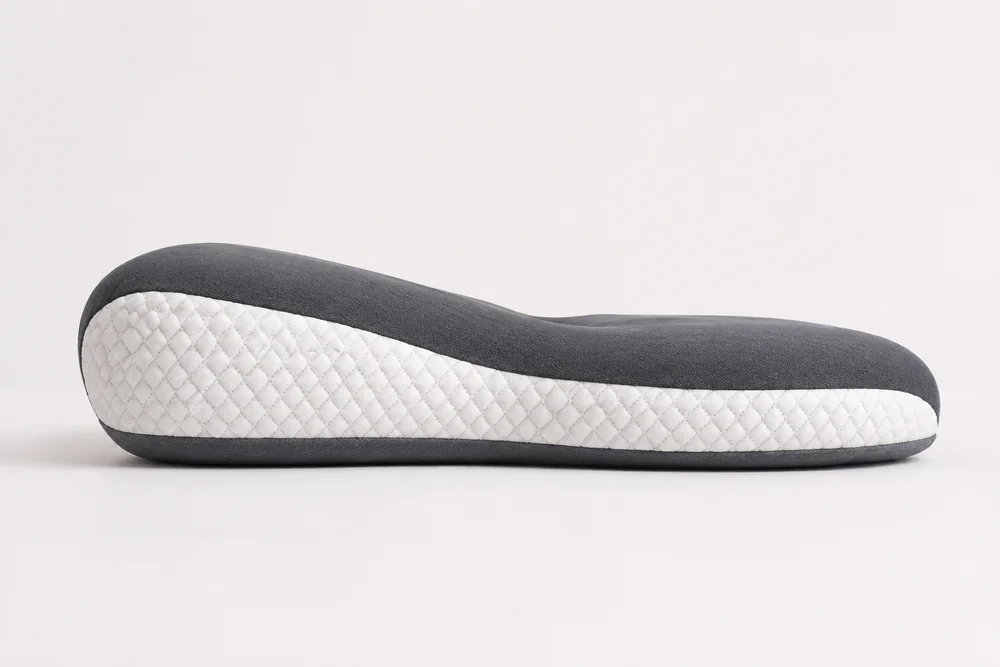
For front sleepers, it genuinely is the better answer
No hedging here: if you sleep on your front, less is better and nothing is often best. Your head is already rotated ninety degrees to let you breathe, and any height under it adds tilt to that rotation — the combination the neck likes least.
Two things do help front sleepers, and neither goes under the head:
- A pillow under the hips. Lifts the heaviest part of you slightly and flattens the arch in your lower back. The single most useful change for this position.
- Alternating which way you face. Always turning the same way shortens the same muscles every night for years.
The full setup for front sleeping.
The thing to check before deciding
Almost nobody spends a whole night in one position. The typical night is three or four positions held for a couple of hours each, and most people who describe themselves as front sleepers start on their front and end up somewhere else.
Check it on yourself for a week: note the position you are in when you wake, and the one you were in if something woke you in the night. If a meaningful share of your night is spent on your side, going pillowless means spending that share with your head tipping toward the mattress — and it is usually where the morning stiffness is coming from.
If you want to try it anyway
Give it two to three weeks, because a neck used to one angle takes that long to settle into another, and the first week can be worse. Then read the direction of travel: better week on week means your geometry suits it, flat or worse means it does not.
And measure rather than guess at the end of it — lie down, have someone photograph you head-on, and check that nose, chin and the notch between your collarbones fall on a straight line. Thirty seconds, and it answers the question for your body rather than in general.