
· Nora Fenwick
Pillowcase, protector or cover: what goes where
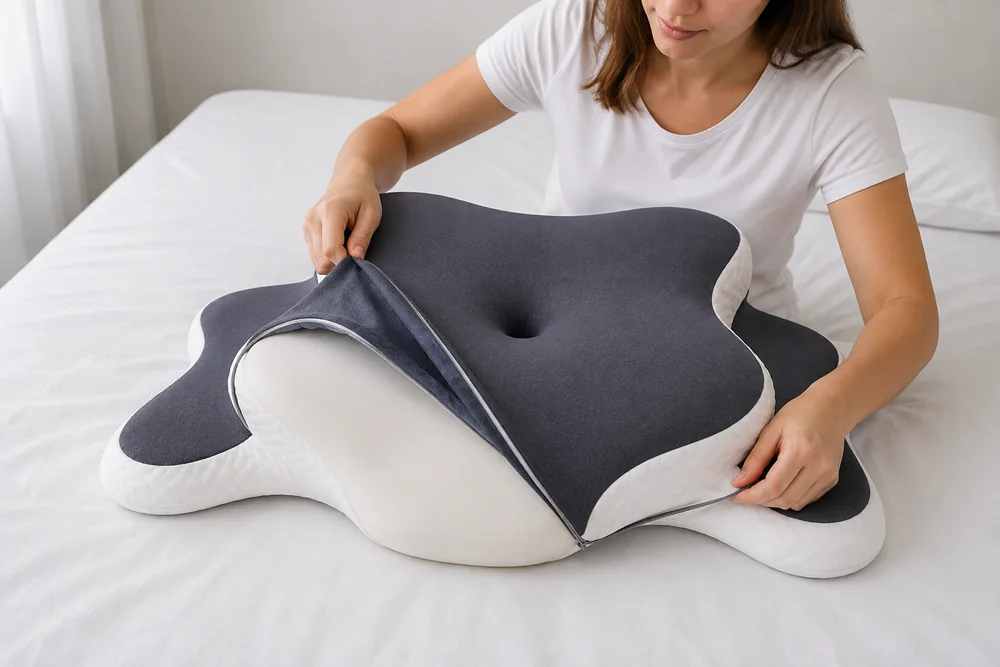
The three layers, from the foam outward
| Layer | What it is for | How often to wash |
|---|---|---|
| 1. The cover (comes with the pillow) | Holds the foam, and its knit is part of the airflow the pillow was designed around | Every 2–4 weeks, 86 °F / 30 °C |
| 2. The protector (optional) | A barrier against moisture, dust mites and spills | Every 1–2 months |
| 3. The pillowcase | Takes the daily wear, matches the bedding | With the sheets, weekly |
Each layer intercepts what would otherwise reach the one below. The pillowcase catches most of the sweat and skin oils; whatever gets past it meets the protector; whatever gets past that meets the cover. Very little should ever reach the foam, and that is the point — the foam is the one part that can never be washed.
Why the zip cover is not optional
People sometimes remove it, on the grounds that a pillowcase is going on anyway. Two reasons not to.
It is doing structural work. On a contour pillow the cover holds the shape and keeps the foam from being handled directly, and its knit is usually the ventilation route — the mesh panels along the sides exist to move air where skin contact lasts longest. Take the cover off and you have removed that.
It is the last washable barrier. Without it, the next thing sweat meets is the foam, and the foam cannot go in a machine. A pillow used bare is a pillow on a much shorter clock. Why water finishes memory foam.
What a protector adds
It depends on one thing: whether you sweat much at night.
Worth it if you sleep hot, if anyone in the house has a dust-mite allergy, or if the pillow is somewhere spills happen — a child's room, a sofa bed. A protector is the difference between moisture stopping at a washable layer and moisture reaching the core, which is what causes the musty smell that never leaves.
Less useful if you sleep cool and already wash the cover regularly. In that case you are adding a fourth thing to launder for a small gain.
One warning worth heeding: waterproof protectors trap heat. A plastic-backed one blocks the airflow the pillow was built around, and people who sleep hot often find it makes the thing they were trying to solve worse. If you want a barrier and you sleep warm, look for one that is described as breathable and is not membrane-backed.
Getting the size right
This is where contour pillows catch people out, and it is worth reading when you choose a case.
Bedding sizes are named, not measured, and the same name means different things depending on where you are. In the US and Canada, Standard is 20 × 26 in, Queen 20 × 30, King 20 × 36. In the UK the "standard" housewife case is 50 × 75 cm — closer to a US or Australian Queen than to a US Standard. In Australia, Standard is 48 × 73 cm.
A contour pillow follows none of them, because its dimensions come from a shoulder width and a neck bolster rather than from linen conventions. Measure the pillow and allow an inch or two.
- Too big and the case floats, creases under your head and leaves marks by morning.
- Too tight and it flattens the relief — which removes exactly the thing you paid for. A case pulled hard over a contour pillow turns it back into a rectangle.
Two habits worth more than any product
No fabric softener. It coats a knitted cover and closes the airflow. It also leaves a residue that holds onto oils, so it works against the layer it is supposed to be softening.
Everything completely dry before it goes back on. Damp fabric against foam is how a musty core starts, and once the smell is in the middle no surface cleaning reaches it. Air drying takes longer than a tumble dryer and a tumble dryer shrinks a knitted cover so it will not go back on — so plan for the wait.
The short version
Cover on the pillow, always. Pillowcase over it, washed weekly with the sheets. Protector in between if you sleep hot or someone has an allergy, and breathable rather than plastic-backed.
That arrangement is the single biggest factor in how long the foam underneath survives — bigger than the brand, bigger than the density, and it costs almost nothing. How to tell when it has run out anyway.