
· Nora Fenwick
What clinicians look for in a pillow
People search this a great deal, so it is worth answering it properly rather than pointing at a product.
Why there is no recommended brand
Three reasons, and they are all structural rather than evasive.
The right pillow is body-specific. The height a person needs comes from their shoulder width and the position they sleep in. Two adults in the same position can be two inches apart. A profession cannot recommend one object to a population whose measurements differ.
Professional bodies do not endorse products. Individual practitioners have preferences, and some brands pay for association with one. That is a commercial arrangement rather than a professional position, and the two get presented as if they were the same thing.
The evidence base is about position, not products. What gets studied and taught is how the neck should sit, not which manufacturer achieves it.
The principle, in one sentence
Keep the head, the neck and the top of the spine in the line they hold when you are standing, for the whole time you are lying down.
That is it. Everything practical follows from it, and it is checkable rather than a matter of opinion — which is the useful part.
What it means in each position
| Position | What has to be filled | What goes wrong |
|---|---|---|
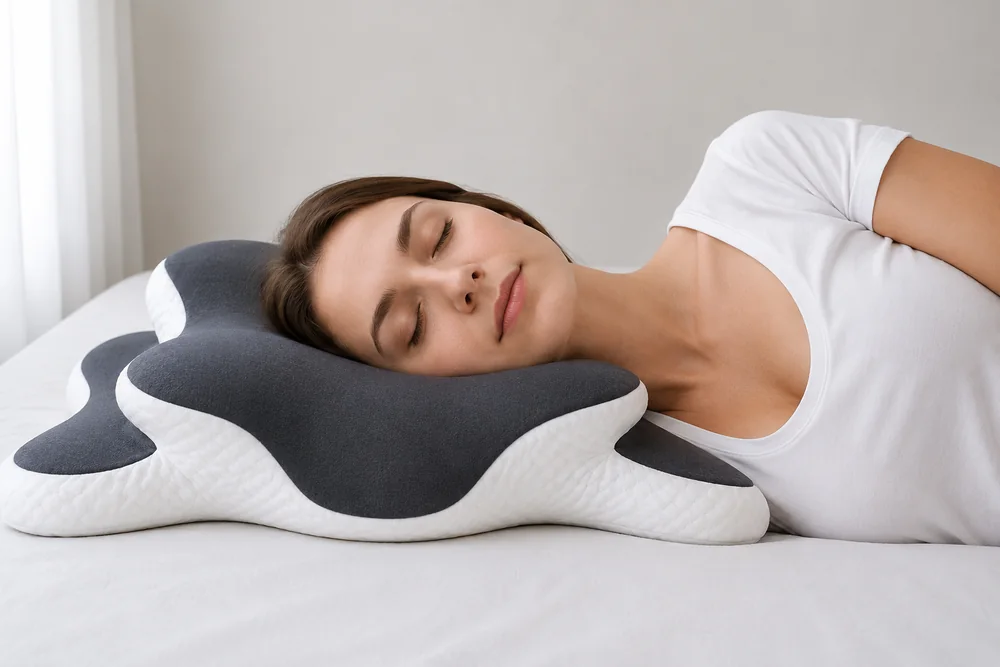
| On your side | The gap from mattress to ear — the width of your shoulder, 4–6 in (10–15 cm) | Too low: head tips down, neck bends sideways for hours |
| On your back | The arch behind the neck only, an inch or two | Too much pillow: chin driven toward the chest |
| On your front | Nothing; the head is already turned | Any height adds tilt to an existing rotation |
Notice what is absent from that table: brands, materials, price. The principle is entirely about geometry, which is why it survives being applied to a cheap pillow and an expensive one alike.
How to apply it without an appointment
The check practitioners use is one you can do at home with a phone and one other person.
- Lie down the way you actually sleep, on the pillow you actually use.
- Have someone photograph you head-on, at the level of the bed.
- Draw a line from your nose, through your chin, to the notch between your collarbones. Straight is right.
Head tipping toward the mattress: not enough height. Chin toward the chest or pointing at the ceiling: too much, or support in the wrong place. The full method, and what to do with the result.
The second thing they check: whether it holds
A pillow that is correct at lights-out and collapsed by midnight has given you the right position for a minute. That is a density question and it is invisible in a shop, because a hand applies a fraction of the load for a fraction of the time.
The test takes three seconds: press a fist into the middle and count the return. Three to five seconds is proper viscoelastic foam. Instant means it is not memory foam. Still dented after ten seconds means the density has gone — and if the shape of your head is still in the pillow when you get up, that is the same finding read from the morning.
What a practitioner sees that a pillow page cannot
This is the boundary, and it is worth stating because it is where a website should stop.
A clinician examines you: how far your neck turns, where it hurts on movement, whether the pain follows a nerve, what your posture does during the day, whether an old injury is involved. None of that is knowable from a product description, and none of it is answered by buying anything.
What a pillow does is remove one variable — the seven hours a night your neck spends in a position you did not choose. That is a genuinely useful thing to remove, and it makes whatever remains easier for someone to identify.
When to make the appointment
Ordinary morning stiffness eases within an hour of getting up. These are different, and they are worth a doctor or a physical therapist rather than another pillow:
- Pain that travels down into the arm, or pins and needles, numbness or weakness in a hand.
- Pain that wakes you at night rather than being worst on waking.
- A neck that will not turn, or a headache that started with the neck pain and is worsening.
- Anything following a fall, a jolt or an accident.
For the selection criteria in order of what matters, see what to look for in a pillow for neck pain. For reading what the stiffness is telling you, this one.