
· Nora Fenwick
Gel memory foam vs memory foam
Which matters, because the two are sold as if they were rival technologies and they are answering different questions.
Why plain memory foam gets warm
Memory foam is a solid, dense material. Unlike a hollow fiber or down, it does not let air move through it freely, and it gives back the heat it stores. Add to that the way it works — it softens with your body heat, so the more it warms up the more of it is in contact with you — and you have a material that runs warmer than the alternatives by design.
That is the problem the gel exists to address. It is a real problem for some sleepers and a non-issue for others, which is most of why opinions on gel pillows are so split.
What the gel actually does
Gel has a higher heat capacity than foam: it absorbs more energy for the same rise in temperature. In practice that means it takes longer to warm up to your skin temperature.
That is a delay, not a refrigerator. Once the gel has reached your body temperature — typically after the first stretch of the night — it stops taking heat away, because nothing is removing the heat from the gel. There is no mechanism in a pillow to move heat out of the room.
So the description is: cooler at lights-out, similar by the middle of the night. For people whose problem is falling asleep hot, that is genuinely useful. For people who wake up hot at three in the morning, it is aimed at the wrong moment.
The three ways gel gets put in
| Form | How it behaves |
|---|---|
| A gel layer or pad on top | The most noticeable at first contact, and the most likely to feel firm or plasticky. Some are a separate sheet that can shift inside the cover. |
| Gel beads through the foam | Milder effect, spread out. Keeps the feel of ordinary memory foam. |
| Gel-infused foam | The gel is part of the mix. The subtlest of the three, and the hardest to verify from a description. |
None of these changes the density, the shape or the way the foam supports. A gel pillow at the wrong height is a wrong-height pillow that is briefly cooler.
What actually moves heat
Airflow does what gel cannot: it takes heat away rather than absorbing it. Which is why the parts of a pillow that make a lasting difference to temperature are structural rather than chemical.
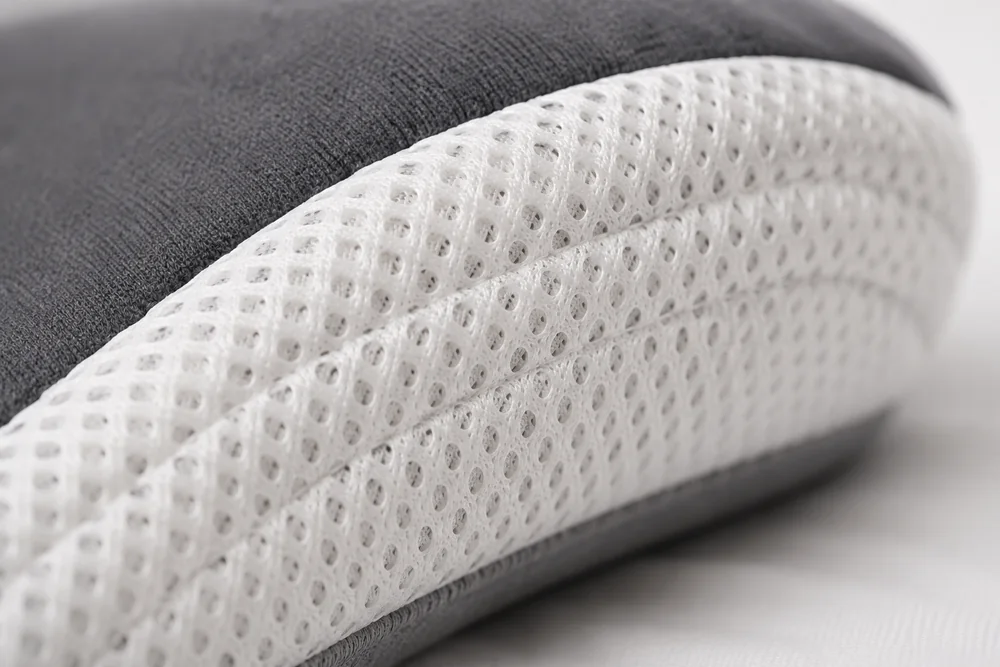
- Woven side panels. The mesh strips along the sides of many contour pillows open an air path exactly where skin contact lasts longest. They are not decorative.
- A knitted cover. An open knit moves air; a tight jersey traps it. This is also why fabric softener is worth avoiding — it coats the knit and closes it.
- Perforations through the core. Holes through the foam do the same job from the inside.
- The room. Unglamorous and larger than all of the above. A bedroom at 18–19 °C (65–66 °F) does more than any pillow feature.
Which one to choose
Decide it in this order, because the order is what people get wrong:
- Height. Does it fill the gap between your head and the mattress in the position you sleep in? Nothing else matters until this is right. Thirty seconds to check.
- Density. Does it hold that height under 11 lb of head for seven hours? Fist test: three to five seconds to return.
- Heat. Only now. If you sleep hot, look for airflow first — mesh sides, a knitted cover, perforations — and treat gel as a bonus on top rather than the deciding feature.
Two practical differences worth knowing
Weight. Gel is denser than foam, so a gel pillow is heavier. Noticeable when you change the cover, irrelevant otherwise.
Feel on the first contact. A gel layer often feels firmer at room temperature than plain foam does, because you are pressing on a material that has not warmed yet. It softens the same way — the delay is simply a little longer. That is worth knowing before you judge one in a shop, where everything is at room temperature and nothing behaves the way it will at night.
What both share
Gel or not, it is memory foam underneath, and the rules are identical. It never goes in a washing machine — the cover does, at 86 °F / 30 °C. It is firm until it warms to skin temperature, which takes two to five minutes and longer in a cold room. And it lasts several years if the density is good, with the wear sign being an impression that is still visible in the morning.
The full care method is in how to wash a memory foam pillow, and how the material behaves night to night is on the memory foam page.